
Saturday, May 27, 2017
Muziek weer terug op school? [Dutch]
Monday, April 24, 2017

Tuesday, April 11, 2017
Is muziek een luxe? [Dutch]

'Muziek is te lang een luxe geweest. Ieder mens heeft gevoel voor muziek, zoals iedereen dat ook heeft voor taal. Maar waar dat gevoel precies vandaan komt, is een wetenschappelijk raadsel.'
Is muzikaliteit aangeboren?
'Het is eerder aanleg. Het is een combinatie tussen wat je via de genen meekrijgt en de omgeving. Uit onderzoek blijkt dat gevoel voor intonatie en ritme al heel vroeg actief is. Zelfs al in de baarmoeder. In de laatste drie maanden van de zwangerschap kan een baby al horen en melodietjes onthouden. Met ons EEG-onderzoek hebben we laten zien dat baby’s daarnaast ook maatgevoel hebben: ze horen de regelmaat in de muziek.’
Hoe onderzoek je de evolutionaire oorsprong van muziek?
‘Daarvoor vergelijken we dit soort resultaten met die van andere diersoorten. Zo proberen we de vraag te beantwoorden of muzikaliteit een oude, met meerdere dieren gedeelde vaardigheid is. Dat lijkt vooralsnog niet zo te zijn. De mens blijkt namelijk de enige apensoort met maatgevoel. Dit delen we, voor zover we nu weten, met slechts twee andere soorten: kaketoes en zeeleeuwen. Kaketoe Snowball en zeeleeuw Ronan zijn beroemd in ons vakgebied vanwege hun maatgevoel. Dat alleen zij maatgevoel met ons delen, is curieus. We weten nog niet waarom dat zo is.’
Zie het volledige interview hier.
Sunday, March 26, 2017
Can birds perceive rhythmic patterns?

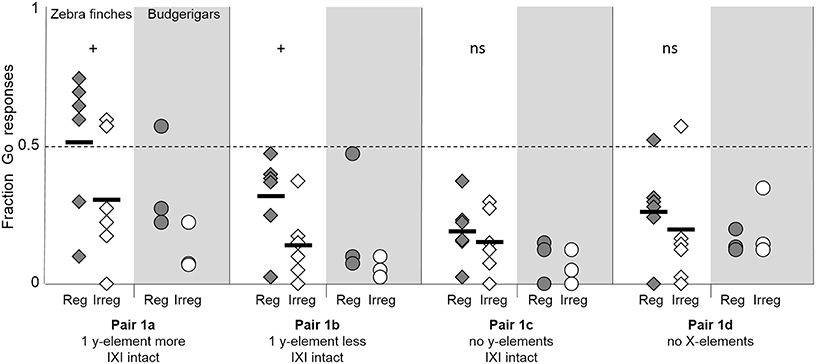 |
| Figure 3 from Ten Cate et al. (2016) |
 van der Aa, J., Honing, H., & ten Cate, C. (2015). The perception of regularity in an isochronous stimulus in zebra finches (Taeniopygia guttata) and humans Behavioural Processes, 115, 37-45 DOI: 10.1016/j.beproc.2015.02.018
ten Cate, C., Spierings, M., Hubert, J., & Honing, H. (2016). Can Birds Perceive Rhythmic Patterns? A Review and Experiments on a Songbird and a Parrot Species Frontiers in Psychology, 7 DOI: 10.3389/fpsyg.2016.00730
van der Aa, J., Honing, H., & ten Cate, C. (2015). The perception of regularity in an isochronous stimulus in zebra finches (Taeniopygia guttata) and humans Behavioural Processes, 115, 37-45 DOI: 10.1016/j.beproc.2015.02.018
ten Cate, C., Spierings, M., Hubert, J., & Honing, H. (2016). Can Birds Perceive Rhythmic Patterns? A Review and Experiments on a Songbird and a Parrot Species Frontiers in Psychology, 7 DOI: 10.3389/fpsyg.2016.00730
Sunday, March 05, 2017
Degelijk stemadvies? [Dutch]

"Een vrijzinnig geluid is een zuiver geluid. [..] Muziek is goed voor de gezondheid van de mens, maar dan wel met de goede natuurlijke grondtoon van 432 Hz."Wat klopt daar van? Kan een stemtoon natuurlijk zijn? Wanneer is muziek vals? En waarom vinden mensen dat zo belangrijk?
Waar de één het verschil tussen 10 trillingen per seconden weet te relativeren, heeft het voor een ander een genadeloze impact. (For a discussion in English, see here and here.)
Zie website Kostgangers en iTunes.
Update: 2 maart 2017
Hilarisch verslag in de Volkskrant: "Vrijzinnige Partij: verlaag de grondtoon, deze wekt verdeeldheid en agressie op"
Wednesday, March 01, 2017
Want to know more about human musicality?
 |
| Cover of The Scientist, Vol. 31, Issue 3 on Music |
Music’s universality in humans, combined with its fundamental social and cultural roles, is convincing evidence to some that our musicality is adaptive.
Are musical tendencies the product of culture, or have they evolved along with our abilities to produce and process music?
If these properties are absent in some cultures, they can’t be strictly determined by something in the biologySee the full issue here.

Tuesday, February 28, 2017
Interested in music, language and cognition?
 |
| Lake Como School of Advanced Study |
The Summer School “Music, Language and Cognition” offers an extended overview of complex behavioral events whose existence is time dependent, including language, music and body movement. We focus on how sounds, melodies, rhythm and syntactic information in music and language may afford the extraction of regularities, the generation of expectations, the coordination of perception and action, the directing of attention, and the priming of interactive social behavior. Lecturers will be integrated by brain storming and students presentations.
See the website more information.
Monday, January 09, 2017
Interested in a PhD in music cognition at the University of Amsterdam?

The Institute for Logic, Language and Computation (ILLC) at the University of Amsterdam (UvA) currently has a PhD position available at the Faculty of Science starting on 1 September 2017 (or as soon after that as possible). Applications are now invited from excellent candidates wishing to conduct research in an area within ILLC (i.e. mathematics, artificial intelligence, linguistics, philosophy, or music cognition) that fits naturally in the Faculty of Science. See website for more information.
N.B. The deadline for applications is 15 February 2017
Friday, December 16, 2016
Interested in becoming the new PA at MCG?
The Music Cognition Group (MCG) searches for an enthusiastic and well-organized personal assistant (PA) for 2017 (0.2 fte for 1 year). For more information and detailed instructions on how to apply see here. N.B. You have to be a student at UvA.
Deadline for applications is 15 January 2017.
Sunday, December 11, 2016
Wanneer stuur je als onderzoeker een persbericht de wereld in? [Dutch]

Dat lijkt te verschillen per vakgebied. Daarom een wetenschappelijke poll met de simpele vraag:
op welk moment stuur je als onderzoeker – wanneer je iets bijzonders te melden hebt, een verrassend feit hebt gevonden, dan wel een bewijs hebt geleverd – een persbericht de wereld in?
Geef hier je mening.
Subscribe to:
Posts (Atom)
