
Een video short van de Universiteit van Nederland.

"Ritmegevoel, je denkt misschien dat je het niet hebt. Maar er is wereldwijd maar bij 6 mensen vastgesteld dat ze het verschil tussen ritmes écht niet kunnen horen. Je hebt dus wel degelijk ritmegevoel. Sterker nog... uit het onderzoek van Henkjan Honing (onderzoeker muziekcognitie aan de Universiteit van Amsterdam) blijkt dat dit niet alleen is aangeleerd, maar aangeboren. Zelfs baby's van een paar dagen oud hebben het door als je iets aan de regelmaat van muziek verandert. En ook sommige apen gaan spontaan bewegen op muziek. Hoe Henkjan hierachter kwam, en waarom we überhaupt ritmegevoel hebben, leer je in deze video."
Meer lezen? Hieronder enkele van de studies die genoemd worden in de video:
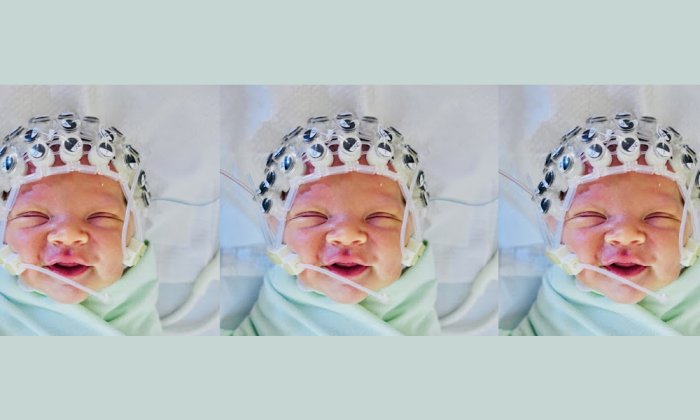 |
| Newborn baby participating in listening experiment (courtesy Eszter Rozgonyiné Lányi). |
[Published in Scientific American and MIT Press Reader]
In 2009, we found that newborns possess the ability to discern a regular pulse – the beat – in music. It’s a skill that might seem trivial to most of us but that’s fundamental to the creation and appreciation of music. The discovery sparked a profound curiosity in me, leading to an exploration of the biological underpinnings of our innate capacity for music, commonly referred to as “musicality.”
In a nutshell, the experiment involved playing drum rhythms, occasionally omitting a beat, and observing the newborns’ responses. Astonishingly, these tiny participants displayed an anticipation of the missing beat, as their brains exhibited a distinct spike, signaling a violation of their expectations when a note was omitted. This discovery not only unveiled the musical prowess of newborns but also helped lay the foundation for a burgeoning field dedicated to studying the origins of musicality.
Yet, as with any discovery, skepticism emerged (as it should). Some colleagues challenged our interpretation of the results, suggesting alternate explanations rooted in the acoustic nature of the stimuli we employed. Others argued that the observed reactions were a result of statistical learning, questioning the validity of beat perception being a separate mechanism essential to our musical capacity. Infants actively engage in statistical learning as they acquire a new language, enabling them to grasp elements such as word order and common accent structures in their native language. Why would music perception be any different?
To address these challenges, in 2015, our group decided to revisit and overhaul our earlier beat perception study, expanding its scope, method and scale, and, once more, decided to include, next to newborns, adults (musicians and non-musicians) and macaque monkeys.
[...] Continue reading in The MIT Press Reader.

Het Amsterdam Dance Event is begonnen. Waarom kunnen sommige mensen niet dansen?
Een gesprek met neurowetenschapper Fleur Bouwer van de Universiteit van Amsterdam. De aflevering is hier te vinden.

'Deze zomer verscheen [..] een kloek wetenschappelijk overzichtswerk The Origins of Musicality, een magnum opus. Honing: „We zijn nu echt verder dan 10, 15 jaar geleden, dankzij nieuwe inzichten uit de biologie. Er heerst een razende hypothesedrift!” In 2000 verscheen bij dezelfde wetenschappelijke uitgeverij (MIT Press) een vergelijkbaar groot handboek onder de titel The Origins of Music, Honing: „Onze nieuwe titel is natuurlijk expres gekozen. Toen ging het om het object: muziek. Nu gaat het over de capaciteit voor muziek. Die menselijke muzikaliteit bestaat op zijn minst uit twéé centrale vermogens, denken we: maatgevoel en relatief gehoor. Dat je dus haast gedachteloos met muziek kan meeklappen of meebewegen én dat je een melodie die iets hoger of lager wordt gezongen gewoon herkent als dezelfde melodie.” '

 |
| The gradual audiomotor evolution (GAE) hypothesis. The GAE hypothesis suggests connections between medial premotor cortex (MPC), inferior parietal lobe (IPL), and primary auditory area (A1) to be stronger in humans as compared to other primates (marked with red lines), suggesting beat-based timing to have gradually evolved. Line thickness indicates the hypothesized connection strength. |
 |
| Foot-tapping shoe competition at the 1994 ICMC in Aarhus, Denmark. |
 |
| A prototype tapping in the P.C.Hoofthuis at the University of Amsterdam in 1993. |
 Honing, H. (2013) Musical Cognition. A Science of Listening. New Brunswick, N.J.: Transaction Publishers. ISBN 978-1-4128-4228-0.
 Hattori, Y., Tomonaga, M., & Matsuzawa, T. (2013). Spontaneous synchronized tapping to an auditory rhythm in a chimpanzee Scientific Reports, 3 DOI: 10.1038/srep01566Hattori, Y., Tomonaga, M., & Matsuzawa, T. (2015). Distractor Effect of Auditory Rhythms on Self-Paced Tapping in Chimpanzees and Humans PLOS ONE, 10 (7) DOI: 10.1371/journal.pone.0130682ten Cate, C., & Okanoya, K. (2012). Revisiting the syntactic abilities of non-human animals: natural vocalizations and artificial grammar learning Philosophical Transactions of the Royal Society B: Biological Sciences, 367 (1598), 1984-1994 DOI: 10.1098/rstb.2012.0055
Phillips-Silver, J., Toiviainen, P., Gosselin, N., Piché, O., Nozaradan, S., Palmer, C., & Peretz, I. (2011). Born to dance but beat deaf: A new form of congenital amusia Neuropsychologia, 49 (5), 961-969 DOI: 10.1016/j.neuropsychologia.2011.02.002
Mathias et al. (in press)
Hannon, E., & Trehub, S. (2005). Metrical Categories in Infancy and Adulthood Psychological Science, 16 (1), 48-55 DOI: 10.1111/j.0956-7976.2005.00779.x
Large, E., & Jones, M. (1999). The dynamics of attending: How people track time-varying events. Psychological Review, 106 (1), 119-159 DOI: 10.1037//0033-295X.106.1.119
Honing, H. (2006). Computational Modeling of Music Cognition: A Case Study on Model Selection Music Perception, 23 (5), 365-376 DOI: 10.1525/mp.2006.23.5.365
Hattori, Y., Tomonaga, M., & Matsuzawa, T. (2013). Spontaneous synchronized tapping to an auditory rhythm in a chimpanzee Scientific Reports, 3 DOI: 10.1038/srep01566Hattori, Y., Tomonaga, M., & Matsuzawa, T. (2015). Distractor Effect of Auditory Rhythms on Self-Paced Tapping in Chimpanzees and Humans PLOS ONE, 10 (7) DOI: 10.1371/journal.pone.0130682ten Cate, C., & Okanoya, K. (2012). Revisiting the syntactic abilities of non-human animals: natural vocalizations and artificial grammar learning Philosophical Transactions of the Royal Society B: Biological Sciences, 367 (1598), 1984-1994 DOI: 10.1098/rstb.2012.0055
Phillips-Silver, J., Toiviainen, P., Gosselin, N., Piché, O., Nozaradan, S., Palmer, C., & Peretz, I. (2011). Born to dance but beat deaf: A new form of congenital amusia Neuropsychologia, 49 (5), 961-969 DOI: 10.1016/j.neuropsychologia.2011.02.002
Mathias et al. (in press)
Hannon, E., & Trehub, S. (2005). Metrical Categories in Infancy and Adulthood Psychological Science, 16 (1), 48-55 DOI: 10.1111/j.0956-7976.2005.00779.x
Large, E., & Jones, M. (1999). The dynamics of attending: How people track time-varying events. Psychological Review, 106 (1), 119-159 DOI: 10.1037//0033-295X.106.1.119
Honing, H. (2006). Computational Modeling of Music Cognition: A Case Study on Model Selection Music Perception, 23 (5), 365-376 DOI: 10.1525/mp.2006.23.5.365
 Merchant, H., & Honing, H. (2014; online). Are non-human primates capable of rhythmic entrainment? Evidence for the gradual audiomotor evolution hypothesis. Frontiers in Neuroscience, 7 (274) 1-8. doi 10.3389/fnins.2013.00274 Honing, H., & Merchant, H. (in press). Differences in auditory timing between human and non-human primates. Behavioral and Brain Science.
 |
| Figure (a) Ai tapped C4, (b) Ai tapped C5, (c) Time sequence of a test trial. |
Hattori, Y., Tomonaga, M., & Matsuzawa, T. (2013). Spontaneous synchronized tapping to an auditory rhythm in a chimpanzee. Scientific Reports, 3 DOI: 10.1038/srep01566. Hasegawa, A., Okanoya, K., Hasegawa, T., & Seki, Y. (2011). Rhythmic synchronization tapping to an audio–visual metronome in budgerigars Scientific Reports, 1 DOI: 10.1038/srep00120Honing, H., Merchant, H., Háden, G., Prado, L., & Bartolo, R. (2012). Rhesus Monkeys (Macaca mulatta) detect rhythmic groups in music, but not the beat. PLoS ONE, 7 (12) DOI: 10.1371/journal.pone.0051369
 |
| Hugo Merchant Lab |
 |
| Macaca mulatta |
Nagasaka, Y., Chao, Z., Hasegawa, N., Notoya, T., & Fujii, N. (2013). Spontaneous synchronization of arm motion between Japanese macaques Scientific Reports, 3 DOI: 10.1038/srep01151
 Bolhuis, J., & Wynne, C. (2009). Can evolution explain how minds work? Nature, 458 (7240), 832-833 DOI: 10.1038/458832a Honing, H., & Ploeger, A. (2012). Cognition and the Evolution of Music: Pitfalls and Prospects Topics in Cognitive Science, 4 (4), 513-524 DOI: 10.1111/j.1756-8765.2012.01210.x
Lewontin, R.C. (1998). The evolution of cognition: Questions we will never answer. In D. Scarborough & S. Sternberg (Eds.), Methods, models, and conceptual issues: An invitation to cognitive science, Vol. 4 (pp. 107-132). Cambridge, MA: MIT Press.
de Waal, F., & Ferrari, P. (2010). Towards a bottom-up perspective on animal and human cognition Trends in Cognitive Sciences, 14 (5), 201-207 DOI: 10.1016/j.tics.2010.03.003
Bolhuis, J., & Wynne, C. (2009). Can evolution explain how minds work? Nature, 458 (7240), 832-833 DOI: 10.1038/458832a Honing, H., & Ploeger, A. (2012). Cognition and the Evolution of Music: Pitfalls and Prospects Topics in Cognitive Science, 4 (4), 513-524 DOI: 10.1111/j.1756-8765.2012.01210.x
Lewontin, R.C. (1998). The evolution of cognition: Questions we will never answer. In D. Scarborough & S. Sternberg (Eds.), Methods, models, and conceptual issues: An invitation to cognitive science, Vol. 4 (pp. 107-132). Cambridge, MA: MIT Press.
de Waal, F., & Ferrari, P. (2010). Towards a bottom-up perspective on animal and human cognition Trends in Cognitive Sciences, 14 (5), 201-207 DOI: 10.1016/j.tics.2010.03.003
'Mathieu was discovered through a recruitment of subjects who felt they could not keep the beat in music, such as in clapping in time at a concert or dancing in a club. Mathieu was the only clear-cut case among volunteers who reported these problems. Despite a lifelong love of music and dancing, and musical training including lessons over several years in various instruments, voice, dance and choreography, Mathieu complained that he was unable to find the beat in music. Participation in music and dance activities, while pleasurable, had been difficult for him.' (from Phillips-Silver et al., 2011)About one year later her group published a journal paper presenting some behavioral evidence that Mathieu was a case of congenital beat deafness.
Phillips-Silver, J., Toiviainen, P., Gosselin, N., Piché, O., Nozaradan, S., Palmer, C., & Peretz, I. (2011). Born to dance but beat deaf: A new form of congenital amusia Neuropsychologia DOI: 10.1016/j.neuropsychologia.2011.02.002 Hasegawa, A., Okanoya, K., Hasegawa, T., & Seki, Y. (2011). Rhythmic synchronization tapping to an audio–visual metronome in budgerigars Scientific Reports, 1 DOI: 10.1038/srep00120
 Fitch, W. (2009). Biology of Music: Another One Bites the Dust Current Biology, 19 (10) DOI: 10.1016/j.cub.2009.04.004Honing H, Ladinig O, Háden GP, & Winkler I (2009). Is beat induction innate or learned? Probing emergent meter perception in adults and newborns using event-related brain potentials. Annals of the New York Academy of Sciences, 1169, 93-6 PMID: 19673760Patel, A. D. (2008). Music, language, and the brain. Oxford: Oxford University Press.Zarco, W., Merchant, H., Prado, L., & Mendez, J. (2009). Subsecond Timing in Primates: Comparison of Interval Production Between Human Subjects and Rhesus Monkeys Journal of Neurophysiology, 102 (6), 3191-3202 DOI: 10.1152/jn.00066.2009
 Phillips-Silver, J., Toiviainen, P., Gosselin, N., Piché, O., Nozaradan, S., Palmer, C., & Peretz, I. (2011). Born to dance but beat deaf: A new form of congenital amusia Neuropsychologia DOI: 10.1016/j.neuropsychologia.2011.02.002Peretz, I. & Hyde, K. (2003). What is specific to music processing? Insights from congenital amusia Trends in Cognitive Sciences, 7 (8), 362-367 DOI: 10.1016/S1364-6613(03)00150-5Honing, H., Ladinig, O., Háden, G., & Winkler, I. (2009). Is Beat Induction Innate or Learned? Annals of the New York Academy of Sciences, 1169 (1), 93-96 DOI: 10.1111/j.1749-6632.2009.04761.xWinkler, I., Haden, G., Ladinig, O., Sziller, I., & Honing, H. (2009). Newborn infants detect the beat in music Proceedings of the National Academy of Sciences, 106 (7), 2468-2471 DOI: 10.1073/pnas.0809035106
 In this weeks online edition of PNAS Marcel Zentner and Tuomas Eerola report on a study in which they carried out two experiments with a total of 120 infants, aged between 5 and 24 months. The infants were exposed to various musical and rhythmic stimuli, including isochronous drumbeats. Control stimuli consisted of adult- and infant-directed speech. The researchers could show that infants engage significantly more in rhythmic movement to music, and other rhythmically regular sounds, than to speech. The findings are suggestive of a predisposition for rhythmic movement in response to music and other metrically regular sounds. The study also adds to the existing evidence that infants have a liking and preference for rhythmical music from day one, a predisposition that preceeds language.Zentner, M., & Eerola, T. (2010). Rhythmic engagement with music in infancy Proceedings of the National Academy of Sciences DOI: 10.1073/pnas.1000121107
