Showing posts with label vocal learners. Show all posts

Thursday, November 06, 2025

Can birds imitate Artoo-Detoo?

The research summarized in an infographic (Dam et al., 2025).

When you think of birds imitating sounds, parrots and starlings might come to mind. They’re famous for copying human speech, car alarms, and even ringtone melodies. But what happens when you challenge them with something really complex, like the electronic beeps and boops of R2-D2, the beloved Star Wars droid? Researchers from the University of Amsterdam and Leiden University put nine species of parrots and European starlings to the test.

Starlings versus parrots

It turns out that starlings had the upper hand when it came to mimicking the more complex 'multiphonic sounds. Thanks to the unique morphology of their vocal organ, the syrinx, which has two sound sources. This allows starlings to reproduce multiple tones at once—perfect for R2-D2-style chatter.

Parrots, on the other hand, are limited to producing one tone at a time (just like humans). Still, they held their own when it came to the simpler “monophonic” beeps of R2-D2. Interestingly, it weren’t the famously chatty African grey parrots or amazon parrots that did best, but the smaller species, like budgerigars and cockatiels. These little birds, often thought of as less impressive vocalists, actually outperformed the larger species in this specific task, likely by using different strategies to imitate sounds.

Even sounds from science fiction can teach us something real

The researchers call their study a fun but powerful window into how anatomy, like the structure of a bird’s vocal organ, can shape the limits and possibilities of their vocal skills. It is the first time that so many different species all produced the same complex sounds, which finally allows for a direct comparison. This shows that even sounds from science fiction can teach us something real about the evolution of communication and learning in animals.

And here’s the cool part: much of the sound data came from pet owners and bird lovers participating in citizen science through the Bird Singalong Project. With their help, the researchers were able to gather a richer, more diverse collection of bird sounds than ever before, proving that science doesn't always have to happen in a lab.

Reference

Dam, N.C.P., Honing, H. & M.J. Spierings (2025). What imitating an iconic robot reveals on allospecific vocal imitation in parrots and starlings. Scientific Reports, 15, 36816. https://doi.org/10.1038/s41598-025-23444-7

Monday, May 19, 2025

Music in our genes?

© ILLC Blog, Illustration by Marianne de Heer Kloots


"In 1984, a curious study on musicality in animals was published. The researchers from Portland, Oregon trained pigeons to distinguish two pieces of music – one by Bach, the other by Stravinsky. If the birds got it right, they were rewarded with food. Afterwards, the same pigeons were exposed to new pieces of music from the same composers. Surprisingly, they were still able to determine which piece was composed by which composer.

This finding confronted researchers with a new set of questions. To what extent are animals musical? What does it even mean for an animal to be musical? And what can this teach us about musicality in humans?" 

(From Music in our genes, ILLC Blog).

The interview is based on an episode of the podcast “Talk that Science” – an initiative started by students from the University of Amsterdam.

• Listen to the episode here (in Dutch);
• Link to the English transcript can be found here.

Sunday, March 26, 2017

Can birds perceive rhythmic patterns?

The specific question whether animals can detect regularity in a stimulus and synchronize their own behavior to arbitrary rhythmic patterns got sudden attention with the discovery of Snowball, a sulphur-crested cockatoo that could synchronize head and body movements with the beat in several popular songs (see earlier entry). Parrots, such as Snowball, are vocal learners and vocal learning is associated with evolutionary modifications to the basal ganglia, which play a key role in mediating a link between auditory input and motor output during learning. As such linkage between auditory and motor areas in the brain is also required for beat induction, Patel suggested that only vocal learning species might be able to show beat induction. However, further studies have shown the picture to be more complicated (see earlier entry) and this calls for a re-examination of the link between vocal learning and beat perception and induction. While zebra finches (vocal learners) are able to discriminate a regular isochronous from an irregular stimulus (Van der Aa et al., 2015), this discrimination was strongly reduced with tempo transformations (changing rate, but not the regularity of the stimulus). Zebra finches seem to attend strongly to specific local features of the individual stimuli (e.g. the exact duration of time intervals) rather than the overall regularity of the stimuli, which was the main feature human listeners attended to (Van der Aa et al., 2015).

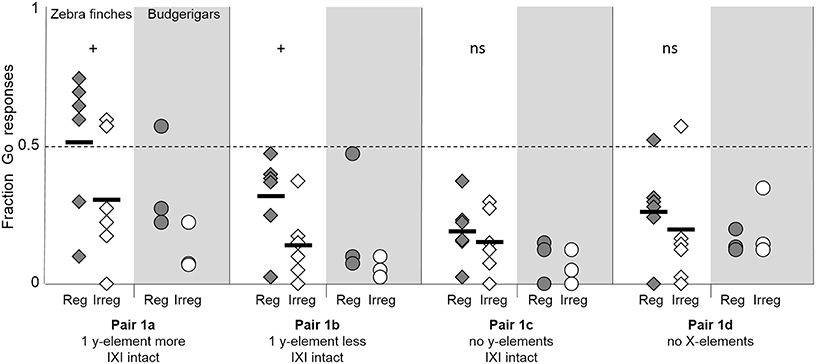
Figure 3 from Ten Cate et al. (2016)
In a recent paper (Ten Cate et al., 2016) we review the available experimental evidence for the perception of regularity and rhythms by birds, like the ability to distinguish regular from irregular stimuli over tempo transformations and report data from new experiments. While some species show a limited ability to detect regularity, most evidence suggests that birds attend primarily to absolute and not relative timing of patterns and to local features of stimuli. We conclude that, apart from some large parrot species, there is limited evidence for beat and regularity perception among birds and that the link to vocal learning is unclear. We next report experiments in which zebra finches and budgerigars (both vocal learners) were first trained to distinguish a regular from an irregular pattern of beats and then tested on various tempo transformations of these stimuli. The results showed that both species reduced the discrimination after tempo transformations. This suggests that, as was found in earlier studies, they attended mainly to local temporal features of the stimuli, and not to their overall regularity. However, some individuals of both species showed an additional sensitivity to the more global pattern if some local features were left unchanged. Altogether our study indicates both between and within species variation, in which birds attend to a mixture of local and global rhythmic features.

ResearchBlogging.org van der Aa, J., Honing, H., & ten Cate, C. (2015). The perception of regularity in an isochronous stimulus in zebra finches (Taeniopygia guttata) and humans Behavioural Processes, 115, 37-45 DOI: 10.1016/j.beproc.2015.02.018

ResearchBlogging.org ten Cate, C., Spierings, M., Hubert, J., & Honing, H. (2016). Can Birds Perceive Rhythmic Patterns? A Review and Experiments on a Songbird and a Parrot Species Frontiers in Psychology, 7 DOI: 10.3389/fpsyg.2016.00730

Thursday, December 18, 2014

Difference between the GAE and VL hypothesis?

Summary diagrams of vocal systems in songbirds, humans, monkeys, and mice. 
(Figure 1 from Petkov & Jarvis in Ackermann et al., 2014).

Today a commentary was published in BBS in which the gradual audiomotor evolution (GAE) hypothesis (Honing & Merchant, 2014) is proposed as an alternative interpretation to the auditory timing mechanisms discussed in the target article by Ackermann et al. (2014).

While often a link is made between vocal learning (VL) and a species' auditory timing skills (e.g., 'entrainment'), the GAE and VL hypotheses show the following crucial differences.

First, the GAE hypothesis does not claim that the neural circuit that is engaged in rhythmic entrainment is deeply linked to vocal perception, production, and learning, even if some overlap between the circuits exists.

Second, the GAE hypothesis suggests that rhythmic entrainment could have developed through a gradient of anatomofunctional changes on the interval-based mechanism to generate an additional beat-based mechanism, instead of claiming a categorical jump from non-rhythmic/single-interval to rhythmic entrainment/multiple-interval abilities.

Third, since the cortico-basal ganglia-thalamic (CBGT) circuit has been involved in beat-based mechanisms in imaging studies, we suggest that the reverberant flow of audiomotor information that loops across the anterior pre-frontal CBGT circuits may be the underpinning of human rhythmic entrainment.

Finally, the GAE hypothesis suggests that the integration of sensorimotor information throughout the mCBGT circuit and other brain areas during the perception or execution of single intervals is similar in human and nonhuman primates.

ResearchBlogging.orgAckermann, H., Hage, S., & Ziegler, W. (2014). Brain mechanisms of acoustic communication in humans and nonhuman primates: An evolutionary perspective Behavioral and Brain Sciences, 1-84 DOI: 10.1017/S0140525X13003099
 
ResearchBlogging.orgHoning, H., & Merchant, H. (2014). Differences in auditory timing between human and non-human primates. Behavioral and Brain Sciences, 27(6), 557-558 DOI: 10.1017/S0140525X13004056. [Alternative link: http://www.mcg.uva.nl/papers/Honing-Merchant-2014.pdf ]
 
ResearchBlogging.orgMerchant, H., & Honing, H. (2014). Are non-human primates capable of rhythmic entrainment? Evidence for the gradual audiomotor evolution hypothesis. Frontiers in Neuroscience, 7 (274) 1-8. doi 10.3389/fnins.2013.00274 

Tuesday, December 31, 2013

Rhythm cognition in humans vs monkeys explained?

This week a theoretical paper will come out in Frontiers in Neuroscience that reviews the literature on rhythm and timing in humans and nonhuman primates observing different species to species behavior in interval-based timing versus beat-based timing.

In this paper we propose the gradual audiomotor evolution hypothesis as an alternative to the vocal learning hypothesis (Patel, 2006) that was recently challenged as a pre-condition to beat perception and rhythmic entrainment (see earlier blogs on rhythmic entrainment in, e.g., chimpansees and sea lions).

The gradual audiomotor evolution hypothesis (Merchant & Honing, 2014; Honing & Merchant, in press) accommodates the fact that nonhuman primates (i.e. macaques) performance is comparable to humans in single interval tasks (such as interval reproduction, categorization, and interception), but show differences in multiple interval tasks (such as rhythmic entrainment, synchronization and continuation). Furthermore, it is in line with the observation that macaques can, apparently, synchronize in the visual domain, but show less sensitivity in the auditory domain.  And finally, while macaques are sensitive to interval-based timing and rhythmic grouping, the absence of a strong coupling between the auditory and motor system of nonhuman primates might be the reason why macaques cannot rhythmically entrain in the way humans do.

Dorsal auditory stream (light blue) and mCBGT in primates (from: Merchant & Honing, 2013).

Functional imaging studies in humans have revealed that the motor cortico-basal ganglia-thalamo-cortical circuit (mCBGT; see Figure) is involved not only on sequential and temporal processing, but also on rhythmic behaviors such as music and dance, where the auditory modality plays a critical role. However, the mCBGT circuit seems to be less engaged in audiomotor integration in monkeys as opposed to humans. While in humans different cognitive mechanisms can be shown to be active for interval-based timing versus beat-based timing, with beat perception being dependent on distinct parts of the timing network in the brain, the anterior prefrontal CBGT and the mCBGT circuits in monkeys might be less viable to multiple interval structures, such as a regular beat.

ResearchBlogging.orgMerchant, H., & Honing, H. (2014). Are non-human primates capable of rhythmic entrainment? Evidence for the gradual audiomotor evolution hypothesis. Frontiers in Neuroscience, 7 (274) 1-8. doi 10.3389/fnins.2013.00274 (Pre-Print).

ResearchBlogging.orgHoning, H., & Merchant, H. (in press). Differences in auditory timing between human and non-human primates. Behavioral and Brain Science.

Wednesday, December 12, 2012

Can rhesus monkeys detect the beat in music?

Beat induction, the ability to pick up regularity – the beat – from a varying rhythm, is not an ability that rhesus monkeys possess. These are the findings of researchers from the National Autonomous University of Mexico (UNAM) and our group in Amsterdam, which are published today in PLOS ONE.

It seems a trivial skill: children that clap along with a song, musicians that tap their foot to the music, or a stage full of line dancers that dance in synchrony. And in way, it is indeed trivial that most people can easily pick up a regular pulse from the music or judge whether the music speeds up or slows down. However, the realisation that perceiving this regularity in music allows us to dance and make music together makes it less trivial a phenomenon.

Previous research showed that not only adult humans, but also newborn babies can detect the beat in music. This proved that beat induction is congenital and can therefore not be learnt. In their experiments with rhesus monkeys, the researchers used the same stimuli and experimental paradigms from previous research conducted on humans and babies. They measured electrical brain signals using electrodes while the participants were listening.

These research results are in line with the vocal learning hypothesis, which suggests that only species who can mimic sounds share the ability of beat induction. These species include several bird and mammal species, although the ability to mimic sounds is only weakly developed, or missing entirely, in nonhuman primates.


In addition, the results support the dissociation hypothesis, which claims that there is a dissociation between rhythm perception and beat perception. This new research suggests that humans share rhythm perception (or duration-based timing) with other primates, while beat induction (or beat-based timing) is only present in specific species (including humans and a selected group of bird species), arguably as a result of convergent evolution.


ResearchBlogging.orgHoning, H., Merchant, H., Háden, G., Prado, L., & Bartolo, R. (2012). Rhesus Monkeys (Macaca mulatta) Detect Rhythmic Groups in Music, but Not the Beat PLoS ONE, 7 (12) DOI: 10.1371/journal.pone.0051369

Saturday, October 13, 2012

A new vocal learner found?

'Singing' male mouse.
In a recent study by Timothy Holy and Zhongsheng Guo (Washington University) it was suggested that male mice produce vocalizations that are songlike, in the sense that they have a melodic structure, sequential and repetitive use of ‘syllables’ (as opposed to what can be called ‘calls’) that are combined in a non-random fashion with repeated motifs. And all this in the ultrasonic domain.

Example of a male adult mouse song (from Arriaga et al, 2012).


This discovery opened the question of whether mice share any behavioral and neural mechanisms for song production and learning with the set of rare vocal learning species, which includes three groups of birds (songbirds, parrots, hummingbirds) and several groups of mammals (humans, cetaceans [dolphins and whales], bats, elephants, and pinnipeds [sea lions and seals]).

In a study that appeared in PLoS ONE two days ago, co-authored by Gustavo Arriaga, Eric Zhou and Erich Jarvis (Duke University), it was shown that a motor cortex region in mice is active during singing, and that it projects directly to brainstem vocal motor neurons that is necessary for keeping song more stereotyped and on pitch.

The Jarvis research team also discovered that the mice depend on auditory feedback to maintain some ultrasonic song features, and that sub-strains with differences in their songs can match each other’s pitch when cross-housed under competitive social conditions.

It was concluded that male mice have some limited vocal modification abilities with at least some neuroanatomical features thought to be unique to humans and song-learning birds. In short: vocal learning seems not so much a species-specific characteristic, present in three groups of birds and several groups of mammals, but more likely to be a continuum.

ResearchBlogging.orgHoly TE, & Guo Z (2005). Ultrasonic songs of male mice. PLoS biology, 3 (12) PMID: 16248680

ResearchBlogging.orgArriaga, G., Zhou, E. P., & Jarvis, E. D. (2012). Of Mice, Birds, and Men: The Mouse Ultrasonic Song-system Has Some Features SImilar to Humans and Song-Learning Birds PLoS ONE, 7 (10) : 10.1371/journal.pone.0046610