Human beings seem to have an innate sense of both rhythm and time, but how much is it biological and how much is it cultural?
Feel free to join the BètaBreak on June 20th between 12:00 and 13:30 at Science Park 904, Amsterdam, to explore the relationship between music and time in an interdisciplinary discussion with insights from biology, evolution, musicology and philosophy with speakers from the University of Amsterdam, the University of Liverpool and the University of Oslo!
'From the beat we hear while still in our mother’s stomachs [sic], to the
teenage anthems we blare out of speakers, to the songs that make and
break our hearts, music is a fundamental part of being human. But why do
we move to a rhythm, are we actually born to be musical, and how does
music really shape who we are?'
This is the first episode of The Rhythm of Life, a series from BBC Reel exploring the power of music.
"Sta je eindelijk weer eens met je partner op de dansvloer, gaat hij nog voor het einde van het eerste nummer op je tenen staan. Hij voelt zich schuldig en jij bent teleurgesteld, want jij wil ook weleens romantisch over de dansvloer zwieren. Maar waarom kan jouw partner dat niet? Heeft-ie een slecht ritmegevoel?"
In deze Universiteit van Amsterdam lezing geeft cognitief neurowetenschapper Fleur Bouwer (Universiteit van Amsterdam, Music Cognition Goup Associate) antwoord op die vraag.
Bouwer, F.L., Honing, H., & Slagter, H. A. (2020) Beat-based and memory-based temporal expectations in rhythm: similar perceptual effects, different underlying mechanisms. Journal of Cognitive Neuroscience, 32(7), 1221-1241. doi: 10.1162/jocn_a_01529
Honing, H., & Bouwer, F. L. (2019). Rhythm. In Rentfrow, P.J., & Levitin, D. (ed.), Foundations in Music Psychology: Theory and Research. Cambridge, Mass.: The MIT Press. ISBN 9780262039277.
Music Cognition: The Basics (Routledge, 2021) considers the role of our cognitive functions, such as perception, memory, attention, and expectation in perceiving, making, and appreciating music. (N.B. Use code SMA09 to get 20% 0ff.)
This volume explores the active role these functions play in how music makes us feel; exhilarated, soothed, or inspired. Grounded in the latest research in areas of psychology, biology, and cognitive neuroscience, and with clear examples throughout, this book concentrates on underappreciated musical skills such as sense of rhythm, beat induction, and relative pitch, that make people intrinsically musical creatures — supporting the conviction that all humans have a unique, instinctive attraction to music.
"Insights from one of the leading researchers working at the intersection of music, psychology, and computer science."
Dan Levitin, author of This is your brain on music
"A graceful and precise introduction into the intricacy of what ordinary humans manage to learn about music, naturally and automatically, just by listening."
Gary Marcus, author of Guitar Zero
"Honing demonstrates that ordinary listeners, whether children or adults, are a lot more musically savvy than they think they are."
Sandra Trehub, Department of Psychology, University of Toronto
Today a novel theme issue of the Philosophical Transactions B came out that assembles current studies that ask how and why precise synchronization and related forms of rhythm interaction are expressed in a wide range of behavior. The studies cover human activity, with an emphasis on music, and social behavior, reproduction and communication in non-human animals.
Greenfield, M. D., Honing, H, Kotz, S A. & Ravignani, A (2021) Synchrony and rhythm interaction: from the brain to behavioural ecology. Phil. Trans. R. Soc. B 376 http://doi.org/10.1098/rstb.2020.0324
De wetenschap barst van wilde ideeën die nog onbewezen zijn. Maar hoe overtuigend zijn ze?
Deze week schrijft Ronald Veldhuizen in de Volkskrant over waarom we houden van dreunende basklanken. Dit naar aanleiding van Todd & Lee (2015), een terugblik op Todd's "wilde" theorie die hij in 2000 presenteerde op een conferentie met de titel "Thank Cod for Rock 'N Roll", en die elegant werd getest door Trainor et al. (2009), maar helaas nooit werd gerepliceerd.
Todd, N. P. M., & Lee, C. S. (2015). The sensory-motor theory of rhythm and beat induction 20 years on: a new synthesis and future perspectives. Frontiers in Human Neuroscience, 9, 444. https://doi.org/10.3389/fnhum.2015.00444
Trainor, L. J., Gao, X., Lei, J. jiang, Lehtovaara, K., & Harris, L. R. (2009). The primal role of the vestibular system in determining musical rhythm. Cortex, 45(1), 35–43. https://doi.org/10.1016/j.cortex.2007.10.014
Lenc, T., Keller, P. E., Varlet, M., & Nozaradan, S. (2018). Neural tracking of the musical beat is enhanced by low-frequency sounds. Proceedings of the National Academy of Sciences of the United States of America, 115(32), 8221–8226. https://doi.org/10.1073/pnas.1801421115
De wetenschap barst van wilde ideeën die nog onbewezen zijn. Maar hoe overtuigend zijn ze? Deze week schrijft Ronald Veldhuizen in de Volkskrant over hoe mogelijk ons wandel- en renritme heeft bijgedragen aan ons talent voor muziek: zie Volkskrant.
Proksch, S., Comstock, D. C., Médé, B., Pabst, A., & Balasubramaniam, R. (2020). Motor and Predictive Processes in Auditory Beat and Rhythm Perception. Frontiers in Human Neuroscience, 14. doi: 10.3389/fnhum.2020.578546
The Institute for Logic, Language and Computation (ILLC) at the
University of Amsterdam (UvA) now invites applications from excellent candidates wishing to conduct postdoctoral research on the computational and (neuro)cognitive underpinnings of rhythm cognition.
For details on the 2-year position and information on how to apply, see UvA-webpage.
An overview comparison of the Action Simulation for Auditory Prediction
Hypothesis (ASAP) and the Gradual Audiomotor Evolution Hypothesis (GAE).
This week a mini review paper appeared in Frontiers in Human Neuroscience (Proksch et al, 2020), comparing two complementary hypotheses for the neural underpinnings of rhythm perception: The Action Simulation for Auditory Prediction hypothesis (ASAP; Patel and Iversen, 2014) and the Gradual Audiomotor Evolution hypothesis (GAE: Merchant and Honing, 2014), In addition to interpreting work under both hypotheses as converging evidence for the predictive role of the motor system in the perception of rhythm, the paper reviews recent experimental progress supporting each of these hypotheses.
Honing, H., & Merchant, H. (2014). Differences in auditory timing between human and non-human primates. Behavioral and Brain Sciences, 27(6), 557–558. https://doi.org/10.1017/S0140525X13004056
Proksch, S., Comstock, D. C., Médé, B., Pabst, A., &
Balasubramaniam, R. (2020). Motor and Predictive Processes in Auditory
Beat and Rhythm Perception. Frontiers in Human Neuroscience, 14. https://doi.org/10.3389/fnhum.2020.578546
The specific question whether animals can detect regularity in a stimulus and synchronize their own behavior to arbitrary rhythmic patterns got sudden attention with the discovery of Snowball, a sulphur-crested cockatoo that could synchronize head and body movements with the beat in several popular songs (see earlier entry). Parrots, such as Snowball, are vocal learners and vocal learning is associated with evolutionary modifications to the basal ganglia, which play a key role in mediating a link between auditory input and motor output during learning. As such linkage between auditory and motor areas in the brain is also required for beat induction, Patel suggested that only vocal learning species might be able to show beat induction.
However, further studies have shown the picture to be more complicated (see earlier entry) and this calls for a re-examination of the link between vocal learning and beat perception and induction. While zebra finches (vocal learners) are able to discriminate a regular isochronous from an irregular stimulus (Van der Aa et al., 2015), this discrimination was strongly reduced with tempo transformations (changing rate, but not the regularity of the stimulus). Zebra finches seem to attend strongly to specific local features of the individual stimuli (e.g. the exact duration of time intervals) rather than the overall regularity of the stimuli, which was the main feature human listeners attended to (Van der Aa et al., 2015).
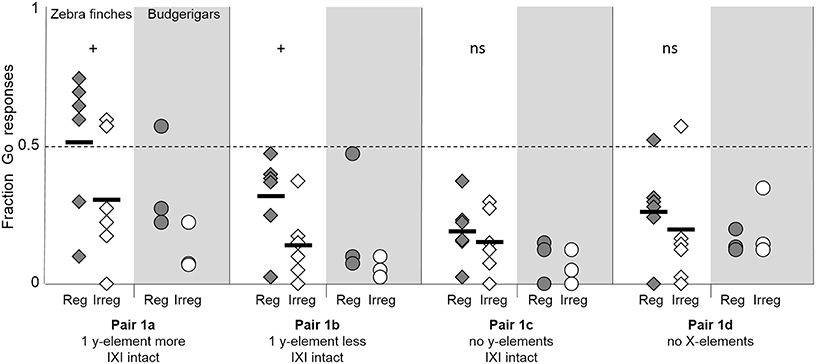
Figure 3 from Ten Cate et al. (2016)
In a recent paper (Ten Cate et al., 2016) we review the available experimental evidence for the perception of regularity and rhythms by birds, like the ability to distinguish regular from irregular stimuli over tempo transformations and report data from new experiments. While some species show a limited ability to detect regularity, most evidence suggests that birds attend primarily to absolute and not relative timing of patterns and to local features of stimuli. We conclude that, apart from some large parrot species, there is limited evidence for beat and regularity perception among birds and that the link to vocal learning is unclear. We next report experiments in which zebra finches and budgerigars (both vocal learners) were first trained to distinguish a regular from an irregular pattern of beats and then tested on various tempo transformations of these stimuli. The results showed that both species reduced the discrimination after tempo transformations. This suggests that, as was found in earlier studies, they attended mainly to local temporal features of the stimuli, and not to their overall regularity. However, some individuals of both species showed an additional sensitivity to the more global pattern if some local features were left unchanged. Altogether our study indicates both between and within species variation, in which birds attend to a mixture of local and global rhythmic features.
van der Aa, J., Honing, H., & ten Cate, C. (2015). The perception of regularity in an isochronous stimulus in zebra finches (Taeniopygia guttata) and humans Behavioural Processes, 115, 37-45 DOI: 10.1016/j.beproc.2015.02.018
ten Cate, C., Spierings, M., Hubert, J., & Honing, H. (2016). Can Birds Perceive Rhythmic Patterns? A Review and Experiments on a Songbird and a Parrot Species Frontiers in Psychology, 7 DOI: 10.3389/fpsyg.2016.00730
Interested in what happened at the 15th edition of the Rhythm Perception and Production Workshop 2015 at the Royal Tropical Institute in Amsterdam? The programme and a photo impression will be made available at www.move.vu.nl/rppw15 soon.
Today PLOS ONE will publish an interesting study on rhythm, groove and syncopation that uses an often criticized methodology: questionnaire and web-based research (cf. Honing & Reips, 2008). However, this study is a good example of how an unspectacular method (compared to brain imaging techniques, elegantly controlled experiments or advanced computational modelling) can still be quite informative.
The paper takes advantage of people's intrinsic interest in rhythm, timing and what's often called 'groove', in combination with the sheer fun of participating in an online listening experiment that has to do with music (cf. Honing & Ladinig, 2008).
Based on sixty-six responses, the authors were able to extract an inverted U-curve for a music-theoretic measure of syncopation, a shape that was absent for an alternative, information-theoretic measure based on the acoustic quality of the soundexamples used (i.e. entropy).
As such the study provides evidence that the theoretical notion of syncopation, as defined by Longuet-Higgins' L-model in the 1980s, might be an important component of 'groovyness': pleasure and dance-inducing aspects of many musics ranging from James Brown to Marvin Gay and from Funkadelic to Stevie Wonder.
The first author, Maria Witek (Aarhus University), encouraged me to mention that the questionnaire and all soundexamples are online. Feel free to take part.
Witek, M., Clarke, E., Wallentin, M., Kringelbach, M., & Vuust, P. (2014). Syncopation, Body-Movement and Pleasure in Groove Music PLoS ONE, 9 (4) DOI: 10.1371/journal.pone.0094446
Honing, H., & Reips, U.-D. (2008). Web-based versus lab-based studies: a response to Kendall (2008). Empirical Musicology Review, 3 (2), 73-77.
Honing, H., & Ladinig, O. (2008). The potential of the Internet for music perception research: A comment on lab-based versus Web-based studies. Empirical Musicology Review, 3 (1), 4-7.
[Press Release University of Amsterdam] Despite their genetic proximity, human and non-human primates differ in their capacity for beat induction, which is the ability to perceive a regular pulse in music or auditory stimuli and accordingly align motor skills by way of foot-tapping or dancing.
Also referred to as ‘rhythmic entrainment’, this ability is specific to humans and certain bird species, but is surprisingly enough not obvious in non-human primates. These are the findings of researchers from the University of Amsterdam and the National Autonomous University of Mexico (UNAM), whose new hypothesis, the ‘gradual audiomotor evolution hypothesis’, was recently published in the scientific journal Frontiers in Neuroscience.
Gradual audiomotor evolution hypothesis
The gradual audiomotor evolution hypothesis accommodates the fact that non-human primates’ (i.e., macaques) performance is comparable to humans in single interval tasks such as interval reproduction, categorisation and interception, but show differences in multiple interval tasks such as rhythmic entrainment, synchronisation and continuation. The hypothesis is also in line with the observation that macaques can apparently synchronise in the visual domain, but show less sensitivity in the auditory domain. Finally, while macaques are sensitive to interval-based timing and rhythmic grouping, the absence of strong coupling between the auditory and motor system of non-human primates might explain why macaques cannot rhythmically entrain in the way humans do.
Timing networks in the primate brain
Functional imaging studies in humans have revealed that the motor cortico-basal ganglia-thalamo-cortical circuit (mCBGT) is not only involved in sequential and temporal processing, but also in rhythmic behaviours such as music and dance, where auditory modality plays a critical role. The mCBGT circuit, however, seems to be less engaged in audiomotor integration in monkeys than in humans. While in humans different cognitive mechanisms are active for interval-based timing versus beat-based timing, with beat perception being dependent on distinct parts of the timing network in the brain, the anterior prefrontal CBGT and the mCBGT circuits in monkeys might be less viable to multiple interval structures, such as a regular beat.
Recent findings weaken the vocal learning hypothesis
The gradual audiomotor evolution hypothesis is an alternative to the well-known ‘vocal learning hypothesis’, which suggests that only species who can mimic sounds share the ability for beat induction. Because recent empirical findings have challenged this hypothesis, an alternative was needed.
Publication details
Merchant, H., & Honing, H. (2014; online). Are non-human primates capable of rhythmic entrainment? Evidence for the gradual audiomotor evolution hypothesis. Frontiers in Neuroscience, 7 (274) 1-8. doi 10.3389/fnins.2013.00274
Honing, H., & Merchant, H. (in press). Differences in auditory timing between human and non-human primates. Behavioral and Brain Science.
Fleur Bouwer, from the Music Cognition Group at the University of Amsterdam, traveled to Canada a few weeks ago to start-up an ambitious experiment on rhythm perception in collaboration with the group of Jessica Grahn, the Music Neuroscience Lab at Western University in London, Ontario. In preparation for a larger fMRI study she invites listeners to join an online pilot study. Interested?
The study involves listening to and rating rhythms online. The entire study will take up to 1 hour to complete and you can participate at a time and location of your convenience. You can also take the experiment in short blocks and take breaks in between. To participate, you need a computer with an Internet connection and loudspeakers or headphones.
Beat induction, the ability to pick up regularity – the beat –
from a varying rhythm, is not an ability that rhesus monkeys possess.
These are the findings of researchers from the National Autonomous University of Mexico (UNAM) and our group in Amsterdam, which are published today in PLOS ONE.
It seems a trivial skill: children that clap along with a song, musicians that tap their foot to the music, or a stage full of line dancers that dance in synchrony. And in way, it is indeed trivial that most people can easily pick up a regular pulse from the music or judge whether the music speeds up or slows down. However, the realisation that perceiving this regularity in music allows us to dance and make music together makes it less trivial a phenomenon.
Previous research showed that not only adult humans, but also newborn babies can detect the beat in music. This proved that beat induction is congenital and can therefore not be learnt. In their experiments with rhesus monkeys, the researchers used the same stimuli and experimental paradigms from previous research conducted on humans and babies. They measured electrical brain signals using electrodes while the participants were listening.
These research results are in line with the vocal learning hypothesis, which suggests that only species who can mimic sounds share the ability of beat induction. These species include several bird and mammal species, although the ability to mimic sounds is only weakly developed, or missing entirely, in nonhuman primates.
In addition, the results support the dissociation hypothesis, which claims that there is a dissociation between rhythm perception and beat perception. This new research suggests that humans share rhythm perception (or duration-based timing) with other primates, while beat induction (or beat-based timing) is only present in specific species (including humans and a selected group of bird species), arguably as a result of convergent evolution.
Honing, H., Merchant, H., Háden, G., Prado, L., & Bartolo, R. (2012). Rhesus Monkeys (Macaca mulatta) Detect Rhythmic Groups in Music, but Not the Beat PLoS ONE, 7 (12) DOI: 10.1371/journal.pone.0051369
Today reached me the sad news that one of the Dutch pionieers in rhythm perception research, Dirk Jan Povel, has passed away after an incurable illness.
Povel made an important contribution to our understanding of the perception of rhythmic patterns reported in a number of highly cited studies. He retired from Radboud University and at the Nijmegen Institute for Information and Cognition (NICI) in November 2005. He taught a few thousand students and was deeply involved in theoretical and applied research in a number of fields. Most notably theoretical and applied research related to speech perception and speech production, the perception of temporal patterns and musical rhythms, and the production of serial motor patterns. More recently he has been doing research on the on-line processes of music perception to discover the perceptual mechanisms listeners use in coding music (see for more information here).
Povel, D. (1981). Internal representation of simple temporal patterns. Journal of Experimental Psychology: Human Perception and Performance, 7 (1), 3-18 DOI: 10.1037/0096-1523.7.1.3
Louis Johnson and Cassandra Phifer-Moore rehearsing “Forces of Rhythm” at Dance Theater of Harlem. Credit Marbeth.
Why do some people dance more rhythmically to music than others? Are these differences genetically or culturally determined? These are some typical questions journalists who are interested in rhythm research like to ask.
The link between musical rhythm and movement has been a fascination for a small yet passionate group of researchers. Early examples, from the 1920s, are the works by Alexander Truslit and Gustav Becking. More recently researchers like Neil Todd (University of Manchester, England) [1] defend a view that makes a direct link between musical rhythm and movement. Direct in the sense that it is argued that rhythm perception can be explained in terms of our physiology and body metrics (from the functioning of our vestibular system to leg length and body size).
While this might be a natural line of thought for most people, the consequences of such theories are peculiar. They predict, for instance, that body length will have an effect on our rhythm perception, longer people preferring slower musical tempi (or rates), shorter people preferring faster ones. Hence, females (since they are on average shorter than men) should have a preference for faster tempi as compared to males.
To me that is too direct and naïve a relation. There are quite a few studies that looked for these direct physiological relations (like heart rate, spontaneous tapping rate, walking speed, etc.) and how these might influence or even determine rhythm perception. However, none of these succeeded in finding a convincing correlation, let alone a causal relation. In addition, they ignore the influence that culture and cognition apparently have on rhythm perception. Nevertheless it should be added that embodied explanations do form a healthy alternative to the often too restricted ‘mentalist’ or cognitive approach.
An intriguing study in that respect was done by Jessica Phillips-Silver and Laurel Trainor (McMaster University, Canada) [2] a few years ago. They did an inventive experiment with seven month old babies, and showed that body movement (i.e. not body size) can influence rhythm perception. They had a group of mothers bounce their infants on a rhythm that could be interpreted as either being in duple or in triple meter. They could show (using a head-turn preference procedure, measuring the time an infant pays attention to a stimulus) that bouncing in three or in four influenced the perception of the infant. While one could be critical on some important details, this is a striking empirical finding, and a small step forward in trying to underpin the relation between rhythm cognition and human movement.
J. Phillips-Silver (2005). Feeling the Beat: Movement Influences Infant Rhythm Perception Science, 308 (5727), 1430-1430 DOI: 10.1126/science.1110922