[Text as published in Nautilus and adapted from The Evolving Animal Orchestra: In Search of What Makes Us Musical (2019, the MIT Press). Chinese version by Levitan; text correction courtesy of Zhi-Yuan Ning (Leiden University).]
利维坦按:我观察了多次,不论播放摇滚乐还是钢琴曲,家里的三只猫明显是毫无反应的,也就是说,基本等于没有听到任何声音的那种状态。于是我很好奇,猫明显是听到了某种“声响”,但这种响动对于它们而言究竟意味着什么呢?
本文基于创作共同协议(BY-NC),由antusen在利维坦发布
文章仅为作者观点,未必代表利维坦立场
我们与生俱来的自发发育的音乐倾向能通过听音乐而被巩固下来。几乎人人都有体验、鉴赏音乐所必需的音乐能力。“相对音感”能力使我们能借助音高或节奏辨认出旋律;“节拍感知”能力使我们得以在千变万化的节奏中找到规律。甚至婴儿对身边的声调、旋律、节奏或动态噪声都异常敏感。所有迹象都表明,人早在诞生之初就做好了感知与享受音乐的生物学准备。
人类的乐感显然是不寻常的。乐感基于且受限于我们的认知能力(注意力、记忆力、预见力)及禀性(生物学意义的),是自发形成的一系列自然特征。但它为何如此特别呢?是因为人类有可能是唯一具备所有这些音乐本领的物种吗?或是因为这些对音乐的倾向也像语言能力那样为人类所独有呢?亦或乐感原本就是人类与其它物种共享的自然进化产物?
《我和狗狗一起弹钢琴》: [link]
研究音乐的亨詹·霍尼(Henkjan Honing)怀疑这个广为流传的视频里的狗狗并没有音高辨别力(一种听力以外的知觉能力),它只能利用主人目光所指示的线索来找到正确的琴键。
达尔文认为所有的脊椎动物应该都能感知、欣赏节奏与旋律,仅仅是基于它们相似的神经系统。他确信人类的乐感是有生物学基础的。此外,他还认为,音乐敏感性肯定是一种非常古老的特质,比语言敏感性还要古老许多。事实上,他认为音乐与语言都起源于乐感,并将其在人类和其它动物中的由来归因于性选择的演化机制。。
那么和人类相比,动物的乐感好到什么程度呢?乐感是人类独有的吗?亦或如达尔文所推测的那样,(人类和动物)“神经系统的生理特性相同”,因而都具有乐感?想了解音乐与乐感的演化过程,我们必须先确定音乐的组成部分是什么,及它们如何在动物和人类身上体现出来。或许我们能借此判断是否只有人类才有乐感。
20世纪初,伊万·巴甫洛夫(Ivan Pavlov)发现,狗能记住某个单音调并将其与食物联系起来。狼、老鼠、椋鸟和恒河猴都能通过叫声的绝对音高识别同类,并能辨别音调。
然而相对音感是一种更具音乐性的听音能力。大多数人听的是整首旋律,而不是专注于一段旋律里的个别音调及其频率。无论对方用高音还是低音唱《玛丽有只小羊羔》,你都能听出那首歌。即便在嘈杂的咖啡馆里听到扩音器里传出的曲调,你仍然能够立即辨认出是哪首歌。
但这是谁唱的呢?你绞尽脑汁想记起歌手的名字或歌曲的名字,然而大脑却一片空白,于是你打开听歌识曲软件,把智能手机对着扬声器,几秒钟内就找到了歌名、歌手和所属专辑。
“存在一种听音模式使得音色这一要素在现代作曲家的作品中占有重要的地位的,鸣禽也具备。”
为了使听音识曲成为可能,软件开发者系统分析并高效保存了大部分可商用的歌曲录音。每首歌都有可以体现其特定声音品质的独特“声学指纹”,这些指纹被储藏在存量浩大的档案中。计算机程序会比对智能手机所接收音乐与存档音乐的“指纹”,进而快速有效地听音识曲。对计算机而言,这简直是小菜一碟,但对人类来说,这几乎是不可能的任务。
然而,如果把智能手机靠向正在唱同一首歌的人,软件要么会表示自己无法识别,要么会乱猜一通。因为数据库中只有有限的经过分析的音乐版本,没有这种随意唱出的音乐,所以软件无法找到对应的“指纹”。而在这种情况下,人类却能立即识别出歌曲,那首歌甚至可能会在他们的脑海中循环播放好几天。
也就是说,计算机会惊讶地发现,无论演唱者音调是高是低,节奏是快是慢,跑调还是不跑调,人类只需要听半首歌就能识别出歌手或歌曲。毕竟对人类而言,听音乐的乐趣之一正是源于聆听音调之间的结构性(包括旋律性和谐和性)。
长期以来,科学家一直认为鸣禽拥有绝对音高辨别力,能根据音高或基频识别并记住旋律。40多年前,美国鸟类研究学者斯图尔特·赫尔斯(Stewart Hulse)以欧洲椋鸟为研究对象,进行了一系列听音实验,进而得出了这一结论。他指出,椋鸟能区分出逐渐升高或降低的音调序列,但却识别不了振动频率略升高或降低的音调序列。赫尔斯的结论是,鸟类关注的是绝对频率。和多数哺乳动物一样,欧洲椋鸟拥有绝对音高辨别力,而非相对音高辨别力。
谈及相对音高辨别力,或者说识别移调乐曲的能力,以人类为观察对象的研究已经比较深入了。神经科学研究表明,使用相对音高辨别力时,需要调用由不同神经机制构成的复杂网络,其中包括听觉与顶叶皮层之间交互作用的神经网络。而鸣禽似乎没有这类神经网络,鉴于此点,当我们研究人类乐感的生物学起源时,其他动物是否也拥有相对音高辨别力这个问题就更加令人着迷了。
据我们目前所知,大多数动物没有相对音高辨别力。人类似乎是个例外。但有人可能会猜测相对音高辨别力是否仅与音高相关。也许乐感并非源于声音的那些绝对物理特征,而是源于这些物理特征之间的结构性关系。
2016年,加州大学圣地亚哥分校的研究人员提供了解答这一问题的方向。他们让椋鸟听了音色、音高都经过处理的不同旋律。使用了俗称音色旋律的刺激物——由不同音色的音调组成的音调序列。他们通过一系列声学实验研究了鸟类是如何利用声学特征对从没接触过的陌生旋律进行归类的。
“鱼能够分辨出约翰·李·胡克(John Lee Hooker)和约翰·塞巴斯蒂安·巴赫(Johann Sebastian Bach)的作品。”
令人惊讶的是,研究人员发现椋鸟并不像预料的那样借助音高来区分刺激物,它们借助的是音色本身及其变化(声谱包络)。即便某首特定的歌曲经过“噪音声码”技术处理后,其中所有音高信息已被去除了,鸟类仍会对这首歌做出反应。由此“噪音声码”技术处理过的音色旋律,其音符切换时缺乏可察觉的音高信息,听起来类似嘈杂之音。就如赫尔斯以欧洲椋鸟为研究对象的实验(使用的刺激物由缺少频谱信息的纯音组成),鸣禽只有在可用的频谱信息极少时才会关注刺激物的音高信息。
鸣禽主要靠频谱信息及其随时间的变化,更确切地说,靠音符切换时频谱能量的变化来感知旋律。而人类关注的是音高,基本不会注意音色。
可以说,鸣禽听旋律的方式就像人类听语音一样。听语音时,人类主要关注的是频谱信息,这让我们能够区分单词“bath”和“bed”。在乐曲中,旋律和节奏是需要关注的重点。就说话而言,音高是次要的——它可以表明说话者的身份或话语的情感意义,但谈及音乐,它便成了首要因素。这就是音乐听觉体验与语音听觉体验之间一个奇异而有趣的区别,只不过目前还难以被人们所理解。
一种可能的解释认为乐感是大脑皮层的副产品,即大脑皮层为语言而生,并且受音乐超常地刺激。然而反过来解释也是有可能的,即乐感先于语言和音乐而存在。根据这种观点,乐感可被解读为人类及许多非人类物种所共有的禀性,只不过在人类身上,这种禀性已演化成为部分地重合的两个认知系统:音乐与语言。
2014年,在奥地利召开的一场国际会议上,笔者偶然发现了支持这一观点的实验证据。在某次讲座中,维也纳大学(University of Vienna)的博士后研究员米歇尔·施皮林斯(Michelle Spierings)曾揭示过斑胸草雀(zebra finches)识别声音序列(她称之为音节)差异的学习过程。这些声音由“mo”、“ca”、“pu”等人类的话语组成。在不同的行为实验中系统地调整这些语音的序列(句法)、音调、音延及动态范围(声谱包络)。
斑胸草雀得先学会区分Xyxy和xxyY序列,其中x和y代表不同的语音,大写字母代表乐调重音:即更高、更长或音量更大的音节。举个例子:“MO-ca-mo-ca”不同于“mo-mo-ca-CA”。
然后,斑胸草雀会听见一段重音、结构都有所变化的陌生序列。该测试目的在于确定鸟类是用乐调重音还是音节顺序来区分语音差异的。
如米歇尔所示,人类主要基于音节顺序来区分差异:譬如abab与aabb不同,而cdcd与abab相似。人类会将abab结构顺序“归纳化”,并推演到尚未听到的cdcd序列。这表明人类听到语音序列时,主要关注的是句法或音节顺序。而句法(一种语序,如“人咬狗”)正是语言的一个重要特征。
相比之下,斑胸草雀主要把注意力放在序列的音乐特质之上,但这并不意味着它们对语序不敏感(其实在某种程度上,它们能理解语序),只不过它们主要靠音高(语调)、时长和力重音(音韵)来区分语音序列。
如果没有解读错的话,研究结果将表明人类的听音模式可能与斑胸草雀一样,这种听音模式关注的是声音的音乐特质(音韵),而非倾听话语时密切关注的句法与语义。
笔者又想起了达尔文。人类和斑胸草雀的听音过程是否密切相关?
针对椋鸟和斑胸草雀的研究表明,鸣禽会收集利用全声谱的信息。它们具有相对音感,基于音色轮廓曲线、语调及声音的动态范围听音。这种音乐理论家早就有所察觉的听音模式已使埃德加·瓦雷兹(Edgard Varèse)、 捷尔吉·利盖蒂(György Ligeti)、卡佳·萨丽亚诺(Kaija Saariaho)等现代作曲家,在他们的作品中尤为着重音色的表现力。
有相对音高辨别力的人不仅仅能听出音高之间的关系。即便面对音高无法辨认的熟识旋律,他们也能借助这声音其他方面的轮廓特征(声谱包络)将其辨认出来。但人们对声谱包络不怎么感兴趣。
一个有趣的问题由此产生:人类需要什么样的特质才能像鸣禽一样听音?或者,反过来说,鸣禽有可能像人类那样听音乐吗?
人类和鸣禽听音时都有自己的策略和偏好。笔者研究斑胸草雀时,发现韵律结构并非此鸟最关注的因素。有证据表明,斑胸草雀最关注语调、音色和动态变化,最不关注声音的时序特征。事实上,对斑胸草雀而言,与歌曲音节间的时序结构相比,韵律蕴含的信息可能更多。
针对斑胸草雀的研究结果迫使笔者意识到,对人类显而易见的东西,对动物却未必如此。当我们不由自主被节奏中的规律性吸引时,斑胸草雀似乎更关注“局部”,如单音或时程。这很好地诠释了美国心理学家詹姆斯·吉布森(James J. Gibson)(也是我最喜欢的)一句妙语:“事可知,而时不可” (“Events are perceivable but time is not”)。只有事件发生时,才能感知时间。在斑胸草雀的例子中,这种“事件”似乎是被它们赋予某些特定特征的单个声音,而非声音序列的时序结构(声音序列承前启后所形成的节奏)。
从这个意义上说,人类的听音模式更具全局性与抽象性,更关注整体。我们过于擅长观察与聆听“结构性”,虽说这些“结构性”通常源于个人经验与预见,而并非真实地存在。这就是为什么我们会惊讶于,其他动物似乎用比人类复杂许多的方式来解决问题。不过,我们眼中最简单的解决方案(结构性)并不总是动物眼中最简单的解决方案(细节性)。
举个出人意料却轻而易举解决视觉领域难题的事例:我们要开发一个搜索算法以便在互联网上找到飞机照片。这是一项艰巨的任务,因为所摄物体(比如鸟、蓝色背景下的白色或金属物体)与飞机某些特征相符的照片数不胜数。
经典的人工智能方案会这样解决问题:创建一个知识导向型系统,该系统可将飞机的典型特征编成的精确规则(可由计算机解释)。这个特征清单可以很长:细长的对称物体、两个机翼、一个机头和一个机尾、两边的小窗户、机头或机尾上的螺旋桨等。编写一份涵盖所有飞机特征的清单虽不容易,但却能将飞机和鸟类及类似飞机的物体区分开。
“如果把智能手机靠向正在唱同一首歌的人,软件无法识别对方在唱什么。”
最新的计算机模拟系统强有力地证明,知识导向型的系统不是判断照片中是否有飞机的最有效方法。所有复杂的推理都是多余的。是否有飞机只需简单关注一个细节:照片中是否有前轮?
常被用于归类实验的斑胸草雀和其它实验动物或许也可以做到这一点。或者说,其实它们倾听的是音乐的“前轮”:与音乐本质无关的某个细节。鸟能记住并辨认出某个独特的细节,这个细节通常是鸟类觅食的有效线索,进而让鸟有必要继续专注于它。
可以肯定的是,人类、鸣禽、鸽子、老鼠和某些鱼(如金鱼和鲤鱼)可以轻易分辨出不同的旋律。但仍然存疑的是,它们在辨别旋律时是否像人类那样利用了音乐的结构性特征。
在北美,某项针对锦鲤(类似金鱼的鱼,听力比大多数鱼好)的研究提供了一个不同寻常的例子。因为听力好,锦鲤常被叫作“听力专家”。它们的听觉灵敏到仿若在通过电话线收听声音:虽然大部分声音高频段及低频段的音质可能比较差,但在它们听起来仍非常的清晰。
三条锦鲤——小美女(Beauty)、奥罗(Oro)和佩皮(Pepi)——生活在哈佛大学罗兰研究所的水族馆内,它们在那里参加过各种各样的听力实验。在早期实验里,它们就已知道按下水箱底部的按钮就会得到食物,但前提是要同时听见音乐。目前,实验主要在研究鲤鱼的音乐识别能力。研究人员不仅会教它们区分两首音乐(辨别能力),还会观察它们是否能识别出不熟悉的音乐是否与某首乐曲类似(归类能力)。
进行辨别实验时,研究人员会播放约翰·塞巴斯蒂安·巴赫和蓝调歌手约翰·李·胡克的作品,并观察锦鲤能否加以区分。在分类实验中,研究人员会测试锦鲤是否能将某乐曲归类为蓝调或古典风格。在后一种实验中,锦鲤会交替聆听到不同蓝调歌手及古典作曲家的作品,从维瓦尔第(Vivaldi)到舒伯特(Schubert)应有尽有。
实验的结果令人惊讶,这三只锦鲤不仅能区分约翰·李·胡克和巴赫的作品,还能区分蓝调及一般古典音乐流派。这些鱼似乎能依据先前学到的音乐区别,正确归类一首从未听过的新乐曲。
但锦鲤这种乐曲归类决策的生物学基础是什么?为何它们能区分乐曲?它们到底听到了什么?研究表明,锦鲤并不是根据乐曲的音色来加以区分的,即便用同一乐器的不同音色演奏古典和蓝调旋律,锦鲤仍然能够做出区分。
锦鲤实验的灵感来自于1984年一项针对岩鸽音乐辨别能力的研究。事实证明,岩鸽也能区分巴赫和斯特拉文斯基(Stravinsky)的作品。而且,和锦鲤一样,岩鸽也能把从两首乐曲中学到的东西应用到其他不熟悉的曲子上。它们甚至能区分与巴赫及斯特拉文斯基同时代之人的作品。
岩鸽和锦鲤能做某些对普通人类听众而言相当困难的事:判断一段音乐是巴赫时代(18世纪)的作品,还是斯特拉文斯基时代(20世纪)的作品。它们无需积累听音经验,无需大量收集音乐,无需定期听音乐会就能做到这点。笔者怀疑它们是靠某个独特的细节(在本质上是一种不寻常的特征)区分乐曲。这个细节很可能有助于它们成功获取食物。然而,我们仍无法借此深入了解音乐“若非享受,则为感知”的内涵。这或许是独属于人类的乐感的某方面表现。
有关作者:亨詹·霍尼是阿姆斯特丹大学音乐认知学教授,著有《进化中的动物管弦乐队:探索是什么让我们拥有乐感及音乐认知学:听音科学》(The Evolving Animal Orchestra: In Search of What Makes Us Musical and Musical Cognition: A Science of Listening)。
Showing posts with label birdsong. Show all posts
Friday, December 20, 2019
Thursday, November 01, 2018
Musicality, explained?
BBC Radio 3 Music Matters: What do birds, crocodiles and the Backstreet Boys have in common?
Scientist Henkjan Honing and Dr Felix Ströckens explain the innate
musical ability of the animal kingdom to Music Matters' Tom Service. (See a link to the discussed book here.)
Fragment from Music Matters (BBC Radio 3).
Sunday, March 26, 2017
Can birds perceive rhythmic patterns?
The specific question whether animals can detect regularity in a stimulus and synchronize their own behavior to arbitrary rhythmic patterns got sudden attention with the discovery of Snowball, a sulphur-crested cockatoo that could synchronize head and body movements with the beat in several popular songs (see earlier entry). Parrots, such as Snowball, are vocal learners and vocal learning is associated with evolutionary modifications to the basal ganglia, which play a key role in mediating a link between auditory input and motor output during learning. As such linkage between auditory and motor areas in the brain is also required for beat induction, Patel suggested that only vocal learning species might be able to show beat induction.
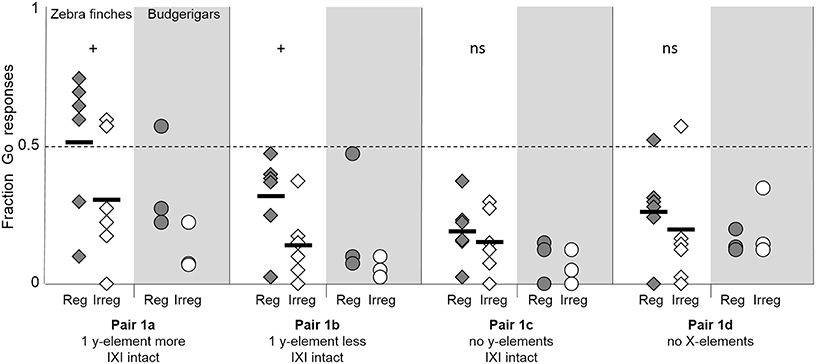
However, further studies have shown the picture to be more complicated (see earlier entry) and this calls for a re-examination of the link between vocal learning and beat perception and induction. While zebra finches (vocal learners) are able to discriminate a regular isochronous from an irregular stimulus (Van der Aa et al., 2015), this discrimination was strongly reduced with tempo transformations (changing rate, but not the regularity of the stimulus). Zebra finches seem to attend strongly to specific local features of the individual stimuli (e.g. the exact duration of time intervals) rather than the overall regularity of the stimuli, which was the main feature human listeners attended to (Van der Aa et al., 2015).
In a recent paper (Ten Cate et al., 2016) we review the available experimental evidence for the perception of regularity and rhythms by birds, like the ability to distinguish regular from irregular stimuli over tempo transformations and report data from new experiments. While some species show a limited ability to detect regularity, most evidence suggests that birds attend primarily to absolute and not relative timing of patterns and to local features of stimuli. We conclude that, apart from some large parrot species, there is limited evidence for beat and regularity perception among birds and that the link to vocal learning is unclear. We next report experiments in which zebra finches and budgerigars (both vocal learners) were first trained to distinguish a regular from an irregular pattern of beats and then tested on various tempo transformations of these stimuli. The results showed that both species reduced the discrimination after tempo transformations. This suggests that, as was found in earlier studies, they attended mainly to local temporal features of the stimuli, and not to their overall regularity. However, some individuals of both species showed an additional sensitivity to the more global pattern if some local features were left unchanged. Altogether our study indicates both between and within species variation, in which birds attend to a mixture of local and global rhythmic features.
van der Aa, J., Honing, H., & ten Cate, C. (2015). The perception of regularity in an isochronous stimulus in zebra finches (Taeniopygia guttata) and humans Behavioural Processes, 115, 37-45 DOI: 10.1016/j.beproc.2015.02.018
ten Cate, C., Spierings, M., Hubert, J., & Honing, H. (2016). Can Birds Perceive Rhythmic Patterns? A Review and Experiments on a Songbird and a Parrot Species Frontiers in Psychology, 7 DOI: 10.3389/fpsyg.2016.00730
![]() |
| Figure 3 from Ten Cate et al. (2016) |
Sunday, May 08, 2016
Can humans listen like songbirds do?
![]() |
| European Starling © www.allaboutbirds.org |
Humans and songbirds share many interesting similarities with regard to their auditory processing capabilities. For example, we know that humans and European Starlings have similar frequency sensitivity, perceive the pitch of the missing fundamental, and parse multiple pure-tone sequences into separate auditory streams. At higher levels, the “musical” nature of birdsong has long been appreciated by humans, and some songbirds can readily learn to discriminate and imitate human melodic sequences (cf. Hoeschele et al., 2015).
Given these similarities, it is surprising to find a major difference in how humans and songbirds perceive sequences of tones. Humans readily recognize tone sequences that are shifted up or down in log frequency because the pattern of relative pitches is maintained (referred to as relative pitch). In contrast, songbirds appear to have a strong bias to rely on absolute pitch for the recognition of tone sequences (a pitch-shifted melody might well be perceived as an altogether different melody; Hoeschele et al., 2015).
Interestingly, a recent study by Bregman et al. (2016), contrasting pitch and spectral patterns, shows that birds perceive their song more like humans perceive speech (Shannon, 2016). More precisely, songbirds might attend more to the acoustic spectral shape than to the absolute pitch of the acoustic signal. Stimuli that preserve acoustic spectral shape, even in the absence of pitch, seem to allow for generalization of learned acoustic patterns. Hence it could well be that a sensitivity to spectral shape is what is shared between human and avian cognition of musical signals, while relative pitch is the preferred mode of listening for humans. And one could wonder: why is sound "super normally stimulated" in humans (see earlier entry), and can humans be made to change their listening mode in the direction of birds (or vice versa) when manipulating melody and spectral shape?
Saturday, February 06, 2016
Do songbirds perceive melody different from humans?
![]() |
| European Starling (Sturnus vulgaris) |
In a series of behavioral experiments, Bregman et al. (2016) find that the human percepts of both pitch and timbre are poor descriptions of the perceptual cues used for melody recognition by the five sparrows that participated in the study. The results suggest that auditory sequence recognition in sparrows might be largely dependent on the perception of acoustic spectral shape, and not just AP. Sounds that preserve this shape, even in the absence of pitch cues, seem to be perceived as equivalent. The finding suggests that songbirds (unlike humans, for whom pitch plays a dominant role in the perception of melodic sequences) rely on a perceptual representation that is a combination of pitch and timbre. It suggests that the perceptual separability of pitch and timbre might also in humans be largely based on experience.
Thursday, April 03, 2014
What makes us musical animals?

The question that will be central in an (invitation-only) workshop that starts next week, will be: What makes us musical animals? The meeting, that is co-organised with Carel ten Cate (Leiden U), Tecumseh Fitch (U Vienna), Isabelle Peretz (U Montréal), and Sandra Trehub (U Toronto), took quite some of my attention in the weeks leading up to it and hence didn't write blog entries for a while... However, if you want to read some exiting new stuff see the references below. These are just a few examples of many recent papers that address what could be the basic components of musicality. More later.
See also some recent media attention related to this topic (In Dutch):
Sunday, October 27, 2013
A Brazilian bird singing like Mozart?
About a week ago the Dutch newspaper de Volkskrant published an article with the title 'Braziliaanse vogel zingt een lied van het niveau Mozart' ('Brazilian bird sings a song of Mozart-level quality'). Several friends send me links via the social media (Thanks, keep on doing that!) because of my interest in what makes us musical animals. Is this striking new evidence? Or another case of anthropomorphism?
Well, let's first listen to a recording of the bird under discussion: the musician wren (Cyphorhinus arada).
Many studies on the origins of music concern the question of what defines music. Can birdsong be considered music? In trying to answer this question, it is important to separate the notions of ‘music’ and ‘musicality’, with musicality being defined as a natural, spontaneously developing trait based on and constrained by our cognitive system, and music as a social and cultural construct based on that very musicality.
However, it is still a challenge to demarcate precisely what makes up this trait we call musicality. What are the cognitive mechanisms that are essential to perceive, make and appreciate music? Only when we have identified these fundamental mechanisms are we in a position to see how these might have evolved. In other words, the study of the evolution of music cognition is conditional on a characterization of the basic mechanisms that make up musicality.
Other studies are concerned with thinking about the question what we share with other animals in terms of musicality. And indeed, no matter how we would like it to be different, we are repeatedly reminded that we have more similarities to nonhuman animals than differences. However, we must be careful in calling birdsong music. We make this mistake more often. We, the human listeners, perceive the sounds made by songbirds as music. Whether these other animals also do that is unclear. And that makes a world of difference.
The study mentioned about a week ago in the Volkskrant was published in the Journal of Interdisciplinary Studies, a relatively new online journal promoting collaborations between the humanities and the sciences (N.B. dated Spring 2012).
If you read the paper, you will see that the authors confirm earlier findings that were discussed on this blog as well. For instance, the study that appeared in Animal Behavior (Araya-Salas, 2012) on the song of a nightingale wren, a species belonging to the same family as the musician wren. In that study ecologist Marcelo Araya-Salas (New Mexico State University) shows that the resemblance between a nightingale wren's song and music is nothing more than a coincidence. In the Doolittle & Brumm (2012) study similar results are reported. They also conclude that it is because 'human listeners from a variety of musical cultures are used to hearing these intervals as frames or anchors, we are likely to perceive many passages of musician wren songs not as series of disjunct notes but as musical units.' (Doolittle & Brumm, 2012:80).
Despite the beauty of birdsong, it’s again an example that when we call something music we’re projecting our own biases. Nothing wrong with that at all, but good to realize.
Nevertheless, from a scientific perspective, one way of avoiding this common pitfall is to focus on the actual, far more challenging question: is it music to them? (cf. Honing, 2013). More on that later...
Doolittle, E. & Brumm, H. (2012). O Canto do Uirapuru:
Consonant intervals and patterns in the song of the musician wren. Journal of Interdisciplinary Music Studies, 6 (1), 55-85. [online advance publication 15 October 2013]
Araya-Salas, M. (2012). Is birdsong music? Evaluating harmonic intervals in songs of a Neotropical songbird Animal Behaviour, 84 (2), 309-313. doi:10.1016/j.anbehav.2012.04.038
Honing, H. (2013). Op zoek naar wat ons muzikale dieren maakt. Free iBook (voorpublicatie).
P.S. In the context of earlier discussions on tuning systems (e.g., see earlier blog entry): this study suggests that we might actually not be so sensitive to tuning as we might think.
Well, let's first listen to a recording of the bird under discussion: the musician wren (Cyphorhinus arada).
Many studies on the origins of music concern the question of what defines music. Can birdsong be considered music? In trying to answer this question, it is important to separate the notions of ‘music’ and ‘musicality’, with musicality being defined as a natural, spontaneously developing trait based on and constrained by our cognitive system, and music as a social and cultural construct based on that very musicality.
However, it is still a challenge to demarcate precisely what makes up this trait we call musicality. What are the cognitive mechanisms that are essential to perceive, make and appreciate music? Only when we have identified these fundamental mechanisms are we in a position to see how these might have evolved. In other words, the study of the evolution of music cognition is conditional on a characterization of the basic mechanisms that make up musicality.
Other studies are concerned with thinking about the question what we share with other animals in terms of musicality. And indeed, no matter how we would like it to be different, we are repeatedly reminded that we have more similarities to nonhuman animals than differences. However, we must be careful in calling birdsong music. We make this mistake more often. We, the human listeners, perceive the sounds made by songbirds as music. Whether these other animals also do that is unclear. And that makes a world of difference.
The study mentioned about a week ago in the Volkskrant was published in the Journal of Interdisciplinary Studies, a relatively new online journal promoting collaborations between the humanities and the sciences (N.B. dated Spring 2012).
If you read the paper, you will see that the authors confirm earlier findings that were discussed on this blog as well. For instance, the study that appeared in Animal Behavior (Araya-Salas, 2012) on the song of a nightingale wren, a species belonging to the same family as the musician wren. In that study ecologist Marcelo Araya-Salas (New Mexico State University) shows that the resemblance between a nightingale wren's song and music is nothing more than a coincidence. In the Doolittle & Brumm (2012) study similar results are reported. They also conclude that it is because 'human listeners from a variety of musical cultures are used to hearing these intervals as frames or anchors, we are likely to perceive many passages of musician wren songs not as series of disjunct notes but as musical units.' (Doolittle & Brumm, 2012:80).
Despite the beauty of birdsong, it’s again an example that when we call something music we’re projecting our own biases. Nothing wrong with that at all, but good to realize.
Nevertheless, from a scientific perspective, one way of avoiding this common pitfall is to focus on the actual, far more challenging question: is it music to them? (cf. Honing, 2013). More on that later...
P.S. In the context of earlier discussions on tuning systems (e.g., see earlier blog entry): this study suggests that we might actually not be so sensitive to tuning as we might think.
Subscribe to:
Posts (Atom)