Showing posts with label newborns. Show all posts

Sunday, December 10, 2023

Why did we decide to revisit and overhaul our earlier beat perception studies?

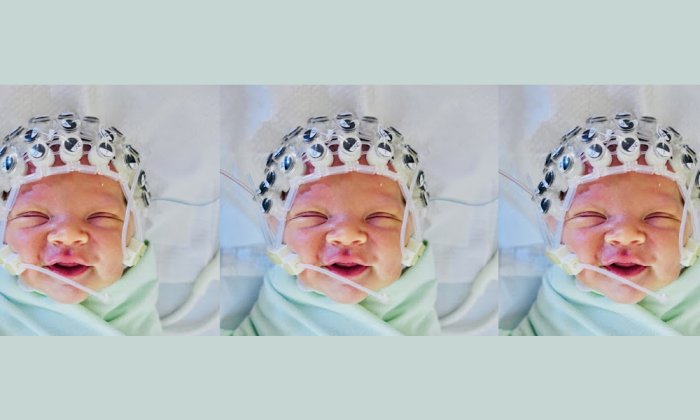
Newborn baby participating in listening experiment
(courtesy Eszter Rozgonyiné Lányi).

[Published in Scientific American and MIT Press Reader]

In 2009, we found that newborns possess the ability to discern a regular pulse – the beat – in music. It’s a skill that might seem trivial to most of us but that’s fundamental to the creation and appreciation of music. The discovery sparked a profound curiosity in me, leading to an exploration of the biological underpinnings of our innate capacity for music, commonly referred to as “musicality.”

In a nutshell, the experiment involved playing drum rhythms, occasionally omitting a beat, and observing the newborns’ responses. Astonishingly, these tiny participants displayed an anticipation of the missing beat, as their brains exhibited a distinct spike, signaling a violation of their expectations when a note was omitted. This discovery not only unveiled the musical prowess of newborns but also helped lay the foundation for a burgeoning field dedicated to studying the origins of musicality.

Yet, as with any discovery, skepticism emerged (as it should). Some colleagues challenged our interpretation of the results, suggesting alternate explanations rooted in the acoustic nature of the stimuli we employed. Others argued that the observed reactions were a result of statistical learning, questioning the validity of beat perception being a separate mechanism essential to our musical capacity. Infants actively engage in statistical learning as they acquire a new language, enabling them to grasp elements such as word order and common accent structures in their native language. Why would music perception be any different?

To address these challenges, in 2015, our group decided to revisit and overhaul our earlier beat perception study, expanding its scope, method and scale, and, once more, decided to include, next to newborns, adults (musicians and non-musicians) and macaque monkeys.

 [...] Continue reading in The MIT Press Reader.

Monday, November 27, 2023

Do babies have a natural affinity for ‘the beat’ ?

Newborn baby participating in listening experiment
(courtesy Eszter Rozgonyiné Lányi).
Today a new study, carried out by a team of scientists from the University of Amsterdam and the HUN-REN Research Centre for Natural Sciences (TTK) in Hungary, shows that the ability to recognize a beat is not simply due to the statistical learning ability of newborns, but that beat perception is actually a separate cognitive mechanism that is already active at birth. The study was published in the scientific journal Cognition.

‘There is still a lot we don't know about how newborn babies perceive, remember and process music,’ says author Henkjan Honing, professor of Music Cognition at the UvA. 'But, in 2009, we found clear indications that babies of just a few days old have the ability to hear a regular pulse in music – the beat – a characteristic that is considered essential for making and appreciating music.’

27 babies
Because the previous research from Honing and his colleagues had so far remained unreplicated and they still had many questions, the UvA and TTK joined forces once again – this time using a new paradigm. In an experiment with 27 newborn babies, researchers manipulated the timing of drum rhythms to see whether babies make a distinction between learning the order of sounds in a drum rhythm (statistical learning) and being able to recognize a beat (beat-induction).

Manipulated timing
The babies were presented with two versions of one drum rhythm through headphones. In the first version, the timing was isochronous: the distance between the sounds was always the same. This allows you to hear a pulse or beat in the rhythm. In the other version, the same drum pattern was presented, but with random timing (jittered). As a result, beat perception was not possible, but the sequence of sounds could be learned. This allowed the researchers to distinguish between beat perception and statistical learning.

Because behavioral responses in newborn babies cannot be observed, the research was done with brain wave measurements (EEG) while the babies were sleeping. This way, the researchers were able to view the brain responses of the babies. These responses showed that the babies heard the beat when the time interval between the beats was always the same. But when the researchers played the same pattern at irregular time intervals, the babies didn't hear a beat.

Not a trivial skill
‘This crucial difference confirms that being able to hear the beat is innate and not simply the result of learned sound sequences,’ said co-author István Winkler, professor at the Institute of Cognitive Neuroscience and Psychology at TTK. 'Our findings suggest that it is a specific skill of newborns and make clear how important baby and nursery rhymes are for the auditory development of young children. More insight into early perception is of great importance for learning more about infant cognition and the role that musical skills may play in early development.'

Honing adds: 'Most people can easily pick up the beat in music and judge whether the music is getting faster or slower – it seems like an inconsequential skill. However, since perceiving regularity in music is what allows us to dance and make music together, it is not a trivial phenomenon. In fact, beat perception can be considered a fundamental human trait that must have played a crucial role in the evolution of our capacity for music.’

Publication details
Gábor P. Háden, Fleur L. Bouwer, Henkjan Honing and István Winkler. Beat processing in newborn infants cannot be explained by statistical learning based on transition probabilities, Cognition, DOI
10.1016/j.cognition.2023.105670.

 [Source UvA Press Office: English version; Dutch version.]

Thursday, October 20, 2022

Are we born to be musical?

'From the beat we hear while still in our mother’s stomachs [sic], to the teenage anthems we blare out of speakers, to the songs that make and break our hearts, music is a fundamental part of being human. But why do we move to a rhythm, are we actually born to be musical, and how does music really shape who we are?'

This is the first episode of The Rhythm of Life, a series from BBC Reel exploring the power of music.

Wednesday, January 30, 2019

Do newborns have a language bias?

Figure from the discussed paper.
Yesterday an intriguing study appeared in Developmental Science of the group of Jacques Mehler†. The research is novel in that it provides evidence for the sensitivity in one or two day old newborns for the statistical structure and prosody of speech. What is not novel is that it is a case of labeling a phenomenon as linguistic, while it could have been labelled otherwise – something I have called earlier the ‘language bias’: the linguist’s understandable enthusiasm to interpret many of nature’s phenomena as linguistic (cf. Honing, 2011).

With regard to prosody there are equally good, if not better, reasons for referring to the sensitivity to patterns of intonation (melody), stress (dynamics), and rhythm as “musical prosody” or musicality. It is no mere coincidence that these patterns also form the building blocks of music. In human development, this musicality is already active around three months before birth. Not only can infants recognize their mother’s voice and distinguish it from other voices, but they can also remember melodies and, after birth, distinguish them from other melodies that they have not heard before. Both the perception and memory of melody are already functional during pregnancy. Unborn babies appear to listen mostly to the sounds as a whole, with special attention to the intonation contours, rhythmic patterns, and dynamic development of the sound. Only much later, when the babies are about six months old, does this musical prosody begin to play a role in what could be called the beginning of language, such as the recognition of word boundaries (see citations in the introduction of the article in Developmental Science). During this phase of development, small tone curves, stress, and specific rhythms help infants to learn their mother tongue (fragment from Honing, 2019:76-77).

In part the observations made in the new study sharpen  earlier interpretations, especially those with regard to the sensitivity of the statistical structure of speech ((Experiment 1; something that was shown to be difficult to replicate after the first studies of, e.g., Marcus et al.). But with regard to prosody (Experiment 2) there are still other interpretations possible. The big challenge (and a nice one!) is to design and perform an experiment that can disentangle both interpretations. It’s on the research agenda!


Fló, A., Brusini, P., Macagno, F., Nespor, M., Mehler, J., & Ferry, A. L. (2019). Newborns are sensitive to multiple cues for word segmentation in continuous speech. Developmental Science, e12802.doi:10.1111/desc.12802

Honing, H. (2011). The Illiterate Listener: On Music Cognition, Musicality and Methodology. Amsterdam University Press.

Honing, H. (2019). The Evolving Animal Orchestra. In Search of What Makes Us Musical. Cambridge, Mass.: The MIT Press.

Hebben pasgeboren baby’s een taal-bias? [Dutch]

Figure 1 from the publication discussed.
Gisteren verscheen er een intrigerend onderzoek in Developmental Science van de groep van Jacques Mehler (LCDL). Het onderzoek is nieuw in de zin dat voor het eerst wordt aangetoond dat pasgeboren baby’s  – een, twee dagen oud –, gevoelig zijn voor de prosodie en statistische structuur van de moedertaal. Wat niet nieuw is dat taalkundigen een eigenschap die net zo goed ‘muzikaal’ genoemd kan worden geclaimd wordt als een talige eigenschap.

Wat prosodie betreft zijn er even goede, zo niet betere redenen te bedenken om deze ontvankelijkheid voor intonatiepatronen (dan wel melodie), klemtoon (dan wel dynamiek) en ritme ‘muzikale prosodie’ of muzikaliteit te noemen. Het zijn niet toevallig ook de bouwstenen van muziek. In de ontwikkeling van een mens is deze muzikaliteit al actief zo’n drie maanden vóór de geboorte. In de baarmoeder kunnen baby’s niet alleen de stem van hun moeder herkennen en onderscheiden van andere stemgeluiden, ze kunnen ook melodieën onthouden en die na de geboorte onderscheiden van melodieën die ze nog niet eerder gehoord hebben. Zowel de waarneming van als het geheugen voor melodie zijn tijdens de zwangerschap al functioneel. Baby’s lijken vooral naar de klanken als geheel te luisteren, met aandacht voor de intonatiecontour (melodie), ritmische patronen en het dynamisch verloop van het geluid. Pas veel later in hun ontwikkeling, als zij zo’n zes maanden oud zijn, gaat deze muzikale prosodie een rol spelen in wat je het begin van taal zou kunnen noemen, zoals het herkennen van woordgrenzen (zie de citaties in de introductie van he artikel in Developmental Science). In die fase van de ontwikkeling helpen kleine toonbuigingen, klemtoon en specifieke ritmes baby’s de moedertaal te leren (citaat uit: Honing, 2018:130-131).

Voor een deel worden deze observaties nu aangescherpt, met name wat betreft de detecteerbaarheid statistische structuur van spraak geluiden (experiment 1). Maar wat de prosodie (experiment 2) betreft is de onderste steen nog niet boven. De grote uitdaging is nu om een experiment te ontwerpen dat deze twee interpretaties uit elkaar kan houden. Binnenkort meer :-)

Fló, A., Brusini, P., Macagno, F., Nespor, M., Mehler, J., & Ferry, A. L. (2019). Newborns are sensitive to multiple cues for word segmentation in continuous speech. Developmental Science, e12802. doi: 10.1111/desc.12802.

Honing, H. (2018). Aap slaat maat. Op zoek naar de oorsprong van muzikaliteit. Amsterdam: Nieuw Amsterdam.

Friday, March 04, 2011

Can infants recognize melodies heard in the womb?

Last week PloS One published an interesting finding that shows that one month old infants can recognize a melody that they heard about three weeks before they were born.

Developmental psychobiologist Carolyn Granier-Deferre (Paris Descartes University, France) and her colleagues asked fifty women to play a brief recording of a descending piano melody (one that gets lower in pitch) twice daily in the 35th, 36th and 37th weeks of their pregnancy. When the infants were one month old, both the descending melody and an ascending melody were played to the babies in the laboratory (while they slept; see notation below). On average, the heart rates of the sleeping babies briefly slowed by about twelve beats a minute with the familiar descending melody (right), and by only five or six beats with the unfamiliar ascending melody (left). A result that was interpreted as the infants paying more attention to the familiar than the unfamiliar melody.


We know for a while that newborns can discriminate or perceive most of the acoustic properties of speech. The prevailing theoretical view is that these capacities are mostly independent of previous auditory experience and that newborns have an innate bias or skill for perceiving speech.

By contrast, these results show (as the authors stress in a press release) that merely exposing a human fetus’ developing auditory system to complex stimuli (read ‘music’) can affect how it functions.

Next to role of mere exposure one should add that this result is equally convincing evidence for a newborn’s capacity of perceiving and recalling music (see my earlier ‘language bias’ entry). In that sense this study adds to the growing literature that shows that infants in the womb are sensitive to, and can memorize both melody and rhythm. These findings play an important role in a further understanding of a potential biological and evolutionary role of music (cf. Parncutt, 2009).

ResearchBlogging.orgGranier-Deferre, C., Bassereau, S., Ribeiro, A., Jacquet, A., & DeCasper, A. (2011). A Melodic Contour Repeatedly Experienced by Human Near-Term Fetuses Elicits a Profound Cardiac Reaction One Month after Birth PLoS ONE, 6 (2) DOI: 10.1371/journal.pone.0017304

ResearchBlogging.orgParncutt, R. (2009). Prenatal development and the phylogeny and ontogeny of musical behaviour. In S. Hallam, I. Cross, & M. Thaut (Eds.), Oxford handbook of music psychology (pp. 219-228). Oxford: Oxford University Press.

Sunday, December 05, 2010

Are we ‘illiterate listeners’? [Part 1]

"French babies cry differently as compared to German babies. This was the conclusion from a study that was published a year ago in Current Biology (see earlier entry). Three day old German babies cry in a downward fashion, their French contemporaries showed an increasing swelling of the cry and stop abruptly.

It was a surprising observation, especially in the light of the general belief that in crying the pitch should always drop as a physiological consequence of the respiratory cycle. Apparently, babies of just a few days old can control both the dynamics and the intonation contour of their crying. Why would they do this?

The researchers interpreted it as the first steps in the development of language. In spoken French the mean intonation contour is rising (dropping at the very end of an utterance), in German the mean intonation typically exhibits a falling contour. This combined with the fact that the human auditory system is already functional in the last trimester of pregnancy made the researchers conclude that these babies picked up the intonation contours of their native language in these last months and consequently imitated them in their crying.

This observation is also surprising since the literature suggests that children only get interested in their native language roughly between six and eighteen months, when they start to imitate it in their babbling. Is it indeed the case, as stressed by these researchers (and the recent literature citing it; e.g. Elk & Hunnius, 2010), that this is unique evidence for a much earlier sensitivity to language than commonly thought? Or is there another interpretation possible?

Although the empirical results are clear, this interpretation is a typical example of what one could call a ‘language bias’: an understandable enthusiasm of linguists to interpret a range of phenomena in the real world as ‘linguistic’. One can, however, easily make the argument that this early sensitivity to intonation contour is a not a linguistic skill but a musical one.

Most linguists see the use of rhythm, dynamics, and intonation as an aid for making infants familiar with the words and sentence structures of the language of the culture in which they will be raised. Words and word divisions are emphasized through exaggerated intonation contours and varied rhythmic intervals, thereby facilitating the process of learning a specific language. These aspects are referred to as prosody, but they are actually the basic building blocks of music. Only much later in the development of a child will this ‘musical prosody’ be used, for instance in the marking, and consequently the recognition of word boundaries. But these early signs of musical skill are — and I like to stress this – not of a linguistic nature. It is the preverbal and preliterate stage of our musical listening in development."

Fragment from inaugural address De ongeletterde luisteraar (Honing, 2010).


ResearchBlogging.orgHoning, H. (2010). De ongeletterde luisteraar. Over muziekcognitie, muzikaliteit en methodologie. Amsterdam: Royal Netherlands Academy of Arts and Sciences (KNAW).

ResearchBlogging.orgMampe, B., Friederici, A., Christophe, A., & Wermke, K. (2009). Newborns' Cry Melody Is Shaped by Their Native Language Current Biology DOI: 10.1016/j.cub.2009.09.064

 ResearchBlogging.orgElk, M. van & Hunnius, S. (2010) Het babybrein, over de ontwikkeling van de hersenen bij baby's. Amsterdam: Bert Bakker.

Friday, April 02, 2010

Anecdotal or real evidence?

This week a short anecdotal yet inspiring video.


However, students referred me to this and this video. So is it music or merely sound that stops the baby from crying? Time for a real experiment...


ResearchBlogging.orgTrehub, S. E. (2009). Music lessons from infants. In: Oxford handbook of music psychology. Oxford: Oxford University Press, 229-234.

Tuesday, February 02, 2010

Crying of newborn babies: A sign of inborn musical skill?

Even the crying of newborn babies seems to be more musical than we think. This can be concluded from an interesting study that was published last month in Current Biology. German researchers were able to show that newborns don’t just cry randomly, but - when studying the audio signal of their crying - one can distinguish between French and German babies. The German babies - only three days old - cry in a downward fashion, their French contemporaries showed an increasing swelling of the cry and stop abruptly.

Sound example: German & French baby cries.

How can we explain these differences? Babies do hear about three months before they are born. And the few prenatal studies that are available show that babies, in that stage of their development, already perceive and remember sounds. For instance, they recognize the sound of their mothers voice just after birth, and they can distinguish between tunes that they heard during pregnancy from those that they have never been exposed to before.

The correlation between the mother language of the babies and their average crying pattern, suggests that exposure to the language spoken by their caregivers (mother, father, etc.) influences the crying, since French language, on average, consists of raising melodies, and German intonation often shows a decreasing shape. The researchers suggest that this as a sign of a sensitivity to language from very early on in life.

My interpretation would be different. I would not so much relate these results to language, as well as a sign of a high sensitivity to the musical aspects of speech: rhythm, melody, stress (i.e. prosody). As quite some studies have shown (e.g., authors like Fernald, Trehub, Trainor, and others), infants and young children are extremely sensitive to these 'musical' variations in their environment. For example, infants seem to be highly sensitive for the musical and emotional aspects of infant-directed speech (IDS), more so than the actual linguistic structure, let alone semantics. I would therefore claim the results of the baby-study are actual evidence for very early signs of musical sensitivity to intonation and other musical aspects of sound, than that it should be seen as evidence for the start of learning a language.

P.S. I describe this argument in length in my new book Iedereen is muzikaal (Available in English in Spring 2011).

ResearchBlogging.orgMampe, B., Friederici, A., Christophe, A., & Wermke, K. (2009). Newborns' Cry Melody Is Shaped by Their Native Language Current Biology DOI: 10.1016/j.cub.2009.09.064

Tuesday, January 27, 2009

Do newborn infants have a sense of rhythm?

[Report related to PNAS Early Edition]

It might look somewhat disturbing, but the picture that accompanies this entry is a snapshot of a two day old baby that is healthy and sound asleep! She is one of fourteen newborns that participated in a recent listening experiment, a collaboration between the Institute for Psychology of the Hungarian Academy of Sciences and our research group at the University of Amsterdam in the Netherlands. In this project we are interested in how newborn infants perceive the musical world around them and in how far certain musical skills are innate.

We know that newborn infants are sensitive to a variety of sounds. But what do they factually hear? Can they make sense of the musical world around them? Do they have a sense of rhythm, arguably one of the fundaments of music?

To study this, we collaborated with a research group in Budapest, Hungary lead by István Winkler, a specialist in auditory perception and one of the pioneers in measuring brain activity in neonates.

Since the start of this European research project (named EmCAP) we talked a lot about how we could take advantage of existing theories in music cognition to study auditory perception in newborn infants, and how to probe their (potential) sense of rhythm. After many pilot studies, and resolving quite a few methodological issues that come with doing experiments with neonates, in the end we opted to use a simple, regular rock rhythm, consisting of hi-hat, snare, and bass drum (see below). We made several variants of this rock rhythm by omitting strokes on non-significant metrical positions (i.e. non-syncopated rhythms in music theoretical terms). We then inserted, once in a while, a 'deviant' segment: the same rhythm but with a missing ‘downbeat’ (i.e. a syncopated rhythm). The result sounded like this [click on the play button; to stop, click again]:

Since it is quite difficult to observe behavioral reactions in newborns a small number of electrodes were carefully glued to the scalp and face of the newborns to be able to measure their electrical brain signals (see photo). N.B. The baby’s were fed just before the measurements with their mother being present during the whole session that lasted twenty minutes.

What did the experiment reveal? Well, shortly after each ‘deviant’ segment began, the babies' brains produced an electrical response indicating that they had expected to hear the downbeat but had not. As such we could show that newborn infants can detect the beat in music (The results will be published this week in PNAS Early Edition).

What are the potential implications of these findings? For me, one of the most important realizations is that a cognitive skill called beat induction, which most of us think of as trivial (e.g., being able to tap your foot to the beat), is active so early in life. It can be seen as additional support for the idea that, beat perception contributed to the origins of music since it enabling such actions as clapping, making music together and dancing to a rhythm. Next to being music-specific, beat induction is also considered to be uniquely human. Even our closest evolutionary relatives, such as the chimpanzee and bonobo, do not synchronize their behavior to rhythmic sounds. This makes the topic of beat induction a fundamental issue in current music cognition research (see, e.g., Patel, 2008:402).

Furthermore, the results challenge some earlier assumptions that beat induction is learned in the first few months of life, for example by parents rocking the infant. Our study suggests that beat perception must be either innate or learned in the womb (as the auditory system is at least partly functional as of approximately three month before birth).

Finally, it should be noted that the auditory capabilities underlying beat induction are also necessary for bootstrapping communication by sounds, allowing infants to adapt to the rhythm of the caretaker’s speech and to find out when to respond to it or to interject their own vocalization. Therefore, although these results are compatible with the notion of the genetic origin of music in humans, they do not provide the final answer in this longstanding debate.

ResearchBlogging.orgIstván Winkler, Gábor P. Háden, Olivia Ladinig, István Sziller, Henkjan Honing (2009). Newborn infants detect the beat in music. Proceedings of the National Academy of Sciences. DOI: 10.1073/pnas.0809035106